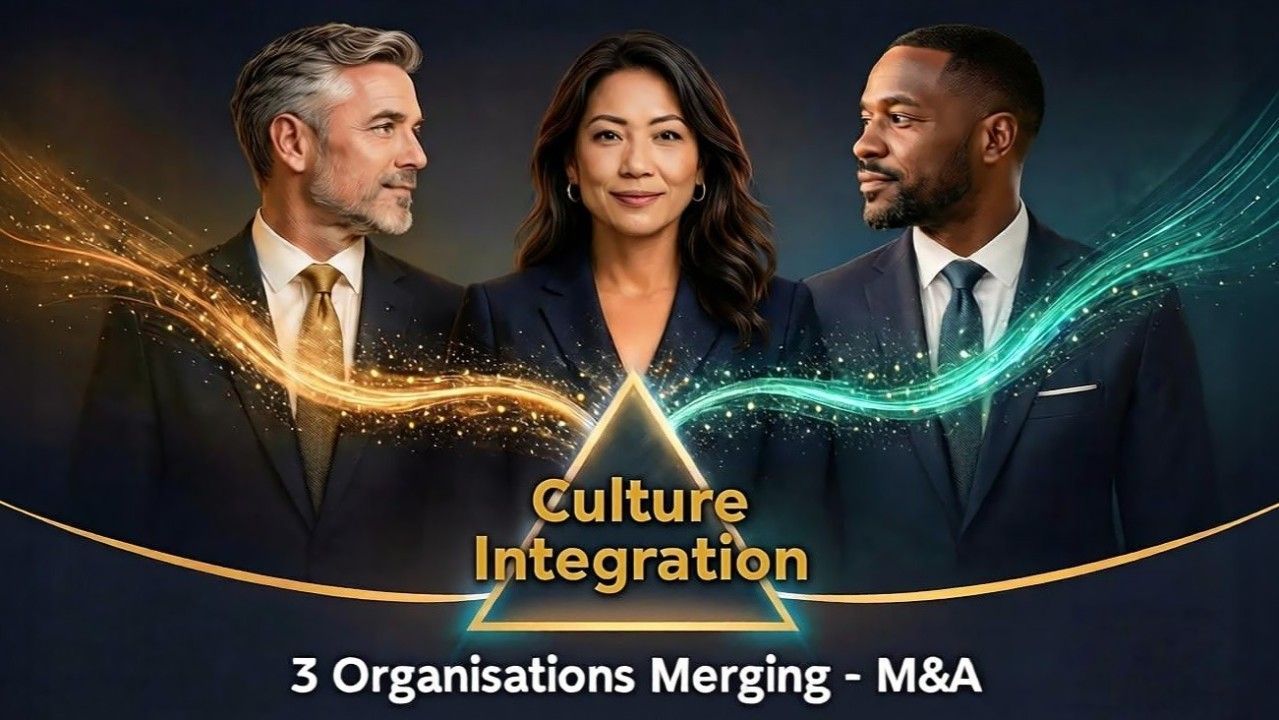
Leadership Alignment and Culture Integration for a Three-Way Merger
Vlatka Hlupic • May 19, 2026


Merging two organisations is difficult. Merging three is exponentially more complex.


In a three-way merger, the challenge is not simply combining systems, structures, and processes. It is aligning three leadership teams, three cultural legacies, and three sets of assumptions about how work gets done. If this is not managed early and deliberately, the result is often predictable: mistrust, slow decisions, talent loss, and value leakage.

That is why culture integration in a triadic merger must be treated as a strategic priority from the outset.


Why three-way mergers are different


Three-way mergers create complexity that scales non-linearly. There are not just two cultures to reconcile, but three distinct organisational histories, values, and ways of working. Leadership dynamics become more fragile, with a greater risk of “2 vs 1” alliances, role ambiguity, and competing centres of influence.

The deeper risk is that traditional diligence often misses these human dynamics. By the time the issues become visible post-close, the damage has already begun. High performers may leave, decisions slow down, and legacy silos quietly re-form.

If the aim is value creation, the leadership and culture agenda must be built into the integration design, not added later.


A 90-day alignment approach


A more effective response is a structured 90-day leadership alignment and culture integration programme. The aim is to quantify the cultural baseline, align the executive team, and create a clear roadmap for early integration wins.


At the Culture Intelligence Institute, the approach begins with diagnosis. Using the Organisational Health Scan and Culture Fit Index, each entity is assessed to identify cultural strengths, friction points, and areas of overlap or conflict. This creates a data-led view of where the new organisation will find alignment and where it will face resistance.


The second step is leadership alignment. A combined executive team workshop can then be used to define shared leadership behaviours, clarify decision rights, and agree the non-negotiable principles that will shape the new organisation. In a three-way merger, this is especially important because trust cannot be assumed; it must be deliberately built.


The final step is execution. The leadership team translates insight into a prioritised integration roadmap, with focus on the highest-risk areas, critical talent retention, and early cultural wins. A pulse check at day 90 helps confirm whether trust, clarity, and collaboration are improving in practice. Figure 1 shows tools and approaches used by the Culture Intelligence Institute to provide culture diligence in three-way M&A projects.
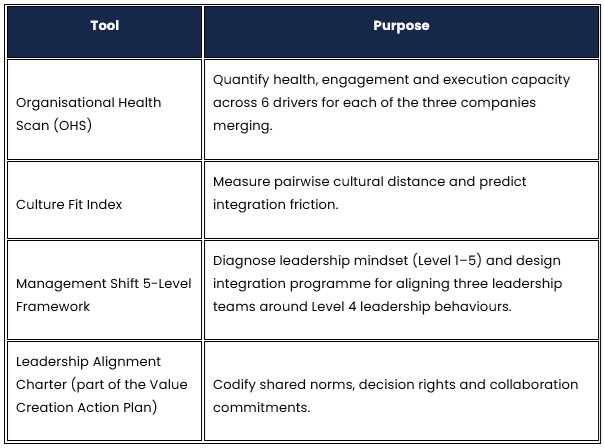


Figure 1 shows mapping of M&A integration to the 5-Level Management Shift Model.


Why this matters


The value of this approach is that it treats culture as measurable, actionable, and central to performance. It does not assume that legacy cultures will naturally blend. Instead, it gives leaders a way to identify what must be protected, what must evolve, and where collaboration must be actively designed.


That is particularly important in a three-way merger, where leadership alignment is often the difference between integration and fragmentation.


The strongest mergers are not only structurally sound. They are culturally coherent. They create a shared leadership model that supports trust, speed, and execution from day one.


From risk to advantage


Three-way mergers will always carry complexity. But complexity does not have to become confusion.


With the right diagnostic tools, leadership framework, and integration discipline, culture can move from being a source of risk to a source of competitive advantage. The key is to align leadership early, make culture visible, and translate insight into action within the first 90 days.


That is where the real value creation begins.


#MergersAndAcquisitions #ThreeWayMergers #CultureIntegration #OrganisationalHealth #LeadershipAlignment #PostMergerIntegration #ValueCreation #ChangeManagement #OrganisationalCulture #ExecutiveLeadership #TalentRetention
By Vlatka Hlupic May 19, 2026
Mergers and acquisitions are often described as financial transactions, strategic plays, or operational combinations. The success or failure of a deal is shaped just as much by culture and leadership as by numbers on a spreadsheet. That is where The Management Shift offers a powerful lens. Its five levels provide a useful way to understand how an organisation behaves, transforms, makes decisions and responds to change. When applied to M&A, the model becomes more than a leadership framework. It becomes a practical tool for diagnosing the human dynamics that determine whether integration creates value or destroys it. Why this matters in M&A Too often, integration planning focuses on systems, governance, and reporting lines while overlooking the deeper question: how do people work together? In a merger, two or more organisations are not only combining structures. They are bringing together different leadership styles, levels of trust, assumptions about authority, and cultural habits. If these are left unaddressed, the result is often predictable: hesitation, friction, poor decision-making, and talent loss. The 5-Level Management Shift Model (framework) helps make those dynamics visible. Each level is described in the context of M&A below. Level 1: Lifeless At Level 1, the organisation is disengaged, passive, toxic and low in energy. People may comply, but they do not contribute with conviction. In an M&A setting, this can show up as anxiety, silence, and a general sense of waiting to see what happens next. This is a dangerous starting point for integration because it creates inertia exactly when momentum is needed most. If leaders do not actively build trust and purpose, the combined organisation can quickly become flat and fragmented. Level 2: Stagnating Level 2 is characterised by people doing only a bare minimum. There may be activity, but little ownership. In an integration, this often appears as slow responses, limited initiative, and a reluctance to go beyond role boundaries. This is especially problematic in M&A, where success depends on collaboration across legacy boundaries. If teams are operating at minimum effort, integration becomes a compliance exercise rather than a shared transformation. Level 3: Orderly At Level 3, leadership is top-down, decision-making is centralised, and processes are tightly managed. This can create clarity in the short term, but it often comes at the cost of flexibility, creativity, and engagement. In M&A, this level is common when leaders feel pressure to impose order quickly. Yet over-control can easily deepen resistance, especially if one legacy organisation is seen as dominating the other. The result is often a “winner and loser” mindset that undermines trust and slows real integration. Level 4: Collaborative Level 4 is where organisations become more collaborative, accountable, entrepreneurial and adaptive. Teams take ownership, leaders enable rather than simply direct, and there is greater energy around shared goals. This is often the most effective operating level for integration. It allows leaders to create alignment without suppressing local initiative. It also encourages cross-functional problem-solving, which is essential when the new organisation needs to move quickly while building a shared identity. For M&A, Level 4 is where integration begins to feel real. People are not just surviving change; they are helping shape it. Level 5: Unbounded Level 5 represents an organisation that is highly innovative, purpose-led, and capable of continuous reinvention. It is not simply efficient; it is transformational. In M&A, this is the most ambitious outcome. It means creating not just a larger organisation, but a better one. A combined business operating at this level does more than preserve value, it generates new value through imagination, trust, and bold leadership. This is where the merger becomes a platform for future growth rather than a compromise between legacy models. Table 1 summarises application of the 5-Level Management Shift Model to M&A, which is especially useful for culture diligence and integration work.
By Vlatka Hlupic May 5, 2026
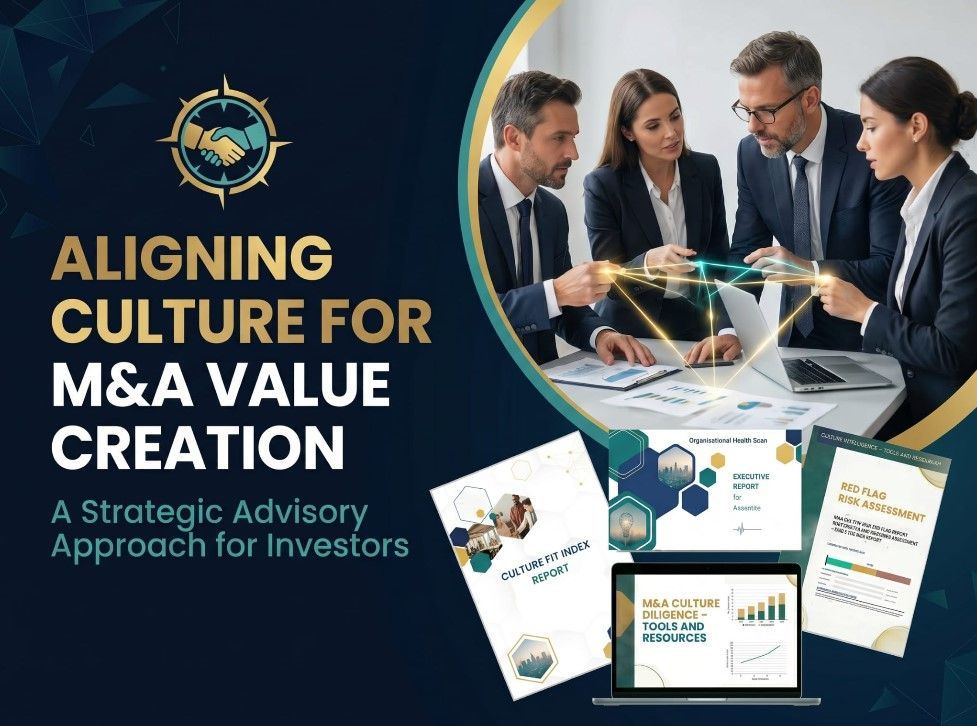
For investors, M&A value creation is rarely limited by the logic of the deal. More often, it is limited by what happens after the deal is announced: integration friction, leadership misalignment, talent flight, and the failure to translate strategic intent into organisational execution. Culture is a major determinant of whether mergers create value or destroy it. McKinsey notes that when organisations get the culture piece right, they are significantly more likely to meet or surpass synergy and revenue targets, while organisational health is strongly correlated with post-deal performance. The message is simple: culture is not a soft issue. It is a value creation lever. Why Culture Belongs in The Investor Playbook Traditional due diligence is strong on financials, legal structure, and commercial opportunity. But it often leaves a blind spot around the human system that must deliver the deal thesis. That blind spot matters. If the leadership team is misaligned, if critical talent is not retained, or if the combined organisation lacks the discipline to execute, then even a well-priced acquisition can underperform. In other words, the value case does not fail in the model; it fails in the organisation. For investors, this means culture should be assessed with the same seriousness as margins, synergies, and capital structure. It should inform deal conviction, integration planning, and post-close value creation. What Strategic Advisory for Value Creation Looks Like A more strategic approach to M&A advisory goes beyond identifying cultural “fit” in a general sense. It translates culture into decision-relevant insight. That means asking: Where are the leadership and behavioural risks? Which parts of the organisation are likely to support or resist change? What will drive or block execution? What must be addressed before close, and what can wait until post-close? This is where the Organisational Health Scan from the Culture Intelligence Institute becomes especially relevant. It provides a diagnostic view across six core drivers of organisational success: Culture, Relationships, Individuals, Strategy, Systems, and Resources. Rather than relying on subjective impressions, it produces structured insight into the human dynamics that influence value creation. How Value Is Created with The Organisational Health Scan The Organisational Health Scan helps investors and deal teams do three things well. First, it identifies hidden risks early. The scan surfaces issues such as weak leadership alignment, poor cross-functional relationships, and cultural friction that may not appear in financial diligence. Second, it supports sharper integration planning. Instead of treating culture as a post-close afterthought, investors can use the findings to shape the 100-day plan, retention priorities, governance model, and leadership focus. Third, it protects value. By making the human system visible, investors can reduce execution risk, improve decision-making, and increase the likelihood that the acquired business delivers its intended growth and return profile. The result is not merely a better understanding of culture. It is a better investment process. What Investors Should Look For The investors who create the most value in M&A tend to treat culture as part of the business case, not as an accessory to it. They ask how the organisation will work after close, not just how the spreadsheet looks before closing the deal. That means focusing on: leadership cohesion, talent retention, accountability and execution discipline, customer focus, and the organisation’s capacity to adapt under pressure. These are precisely the conditions that influence whether the deal thesis becomes reality. That is why culture diligence should sit alongside commercial diligence. It improves conviction before the deal and execution after the deal. The most effective investors do not merely acquire assets. They build the conditions for those assets to perform. People and culture are among most valuable assets that determine the success of execution. #M&A #ValueCreation #PrivateEquity #OrganisationalHealth #CultureDiligence #Integration #Leadership #Execution #PostMergerIntegration #TheCultureIntelligenceInstitute
By Vlatka Ariaana Hlupic April 27, 2026
In M&A, strategy gets the attention. Leadership alignment determines whether the deal works. Too often, acquirers focus on financials, synergies, and operating models, while assuming the combined leadership team will naturally align after close. The most common source of post-deal friction is not strategy, it is the collision of two leadership cultures, two decision-making styles, and two sets of assumptions about how value gets created. That is where The Management Shift framework (Figure 1) is especially useful. It helps explain why leadership alignment matters so much, and why the move to Level 4 (of this framework) is critical in a merger context.
By Vlatka Hlupic April 14, 2026
In good times, M&A is often sold as a story of growth, expansion, and synergy. Cultural friction can be overlooked when markets are strong, bonuses are high, and confidence is rising. But in times of recession, inflation, or war, the picture changes fast. The economy becomes a stress test for corporate culture, revealing how organisations really behave under pressure. When uncertainty rises, M&A is no longer just about scale or market position. It becomes a test of resilience, trust, psychological safety, and leadership judgement. Recessions: Survival mode In a recession, M&A often shifts from growth to consolidation, cost synergies, or distressed acquisitions. That changes the cultural dynamic immediately. A common risk is the “conqueror versus conquered” mindset. A stable acquirer may unconsciously signal, “we saved you,” which can create resentment and damage trust. Recessions also bring fear of layoffs, which leads to defensiveness, information hoarding, and self-preservation. Instead of collaboration, people protect their own position. For buyers, the key question becomes: can this organisation stay resilient under pressure ? Inflation: Scarcity mode Inflation creates a different kind of pressure. Margins tighten, costs rise, and employees feel the squeeze personally. This is where pay disparities and fairness issues become explosive. If one company protects salaries while the other cuts back, resentment can build quickly. Inflation also exposes weak culture. If a business relied on perks rather than purpose, those benefits disappear fast once budgets tighten. At the same time, inflation pushes leaders into short-term thinking. That can clash with a target that is built around long-term innovation and investment. War and geopolitical instability: Values mode War and geopolitical tension add a deeper layer of complexity to M&A. Companies increasingly think in terms of nearshoring and friend shoring, which makes political alignment part of the deal conversation. Psychological safety also becomes critical. Employees want to know whether leadership will protect them, communicate clearly, and act with empathy.  War forces hard ethical choices too. If one company is purpose-driven and the other is purely profit-driven, culture conflict can surface fast after the deal closes. The crucible effect Crises can also strengthen integration. Organisational psychologists call this the crucible effect. Shared adversity can break down silos and accelerate bonding, but only if leadership is transparent, honest, and human. Handled well, pressure can create unity. Handled poorly, it can destroy trust. How the Organisational Health Scan helps In volatile markets, the biggest M&A risks are often human, not financial. Anxiety rises, trust becomes fragile, and employees quickly notice whether leadership is clear, fair, and empathetic. This is where the Organisational Health Scan from the Culture Intelligence Institute becomes especially valuable. It helps leaders spot cultural strengths, surface hidden risks, and identify where friction and misalignment are likely to emerge during integration. That means issues such as low psychological safety, unclear decision-making, or poor communication can be addressed early. Used well, it becomes a navigation system for post-merger integration, helping leaders move from reactive damage control to proactive culture building that will lead to higher returns. Summary In normal times, culture in M&A is about alignment. In times of recession, inflation, and war, culture in M&A is about resilience, empathy, and psychological safety. The best M&A leaders understand this: culture is not a soft issue. In uncertain times, it is the operating system that determines whether the deal creates lasting value or collapses under pressure. #MergersAndAcquisitions #M&A #CorporateCulture #Leadership #PostMergerIntegration #Resilience #PsychologicalSafety #Strategy #OrganisationalHealth #Culture
By Vlatka Hlupic April 9, 2026
In SaaS, M&A is often sold as a shortcut to scale, capability, or market dominance. Yet deal after deal shows that the biggest risk is not the technology, the TAM, or even the price, it is culture. Using the 5 Levels of Culture from The Management Shift framework (see Figure 1), we can move beyond vague “culture fit” conversations and diagnose exactly where and why these deals fractured.
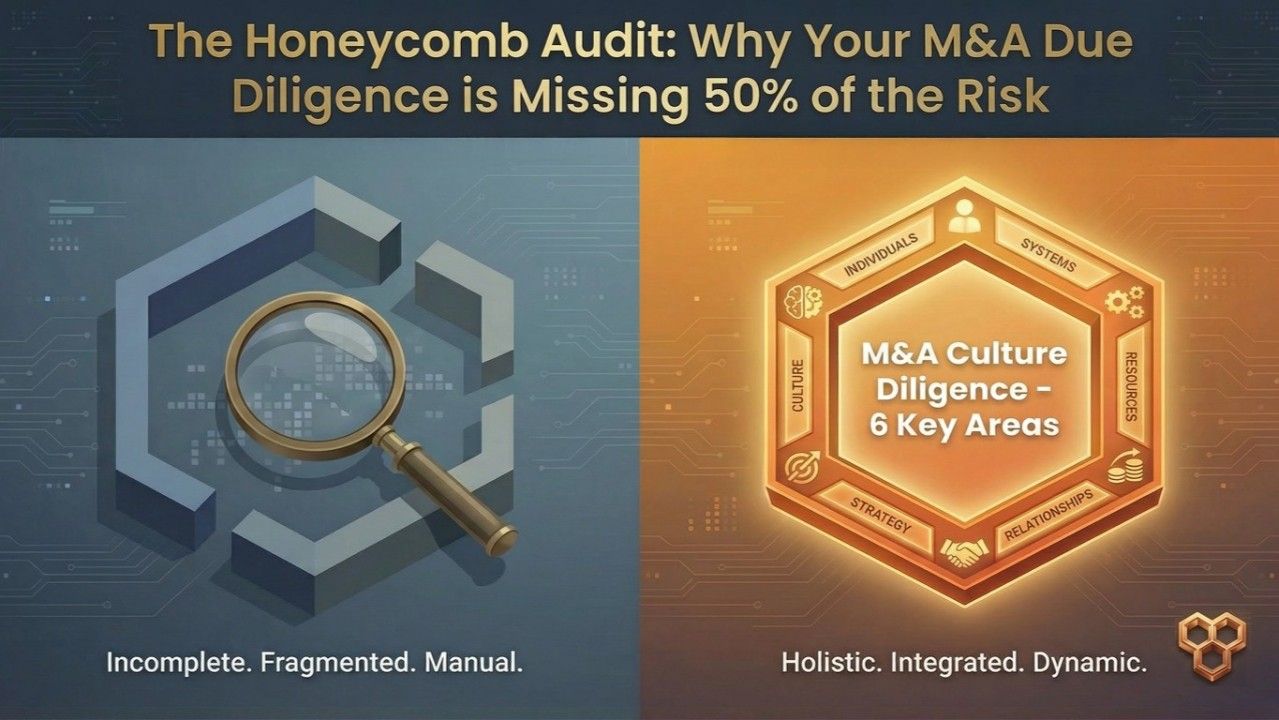
The Honeycomb Audit: Why Your M&A Due Diligence is Missing 50% of the Risk
By Vlatka Ariaana Hlupic April 1, 2026
The Honeycomb Audit: Why Your M&A Due Diligence is Missing 50% of the Risk
By Vlatka Ariaana Hlupic March 29, 2026
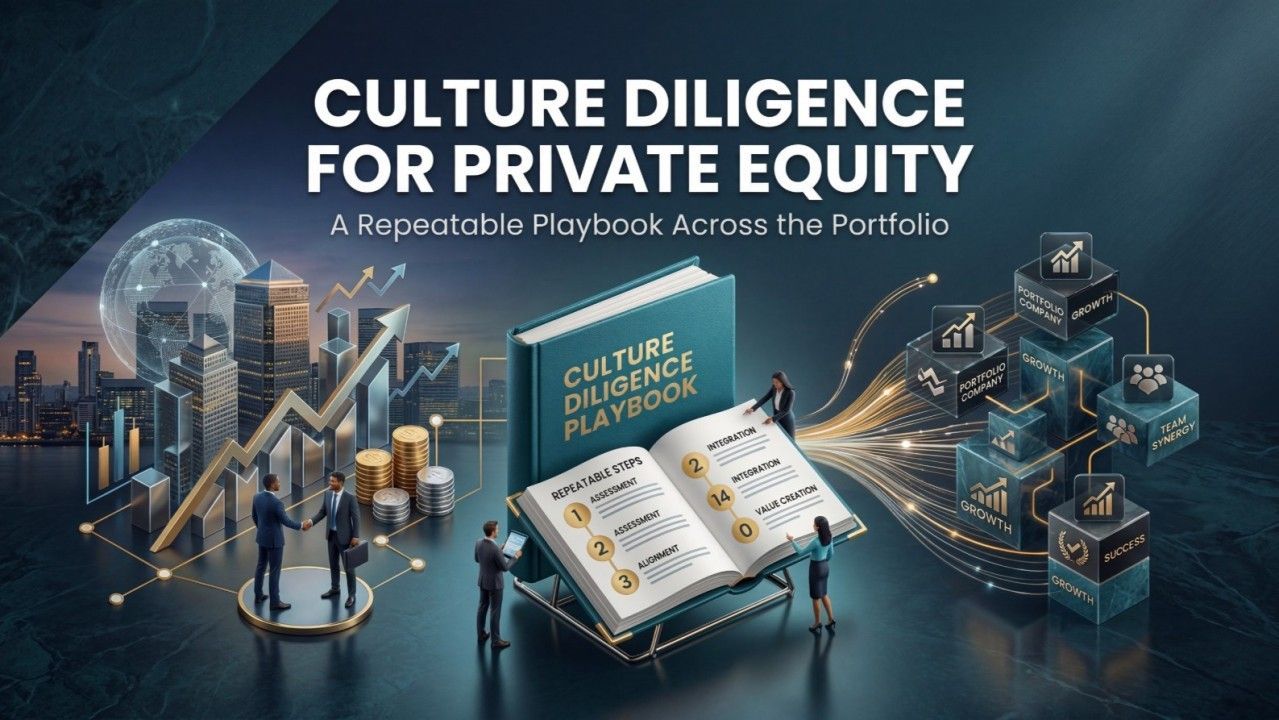
For years, PE value creation has focused on financial engineering, cost optimisation and commercial synergies. But in platform and add‑on strategies, the real execution risk sits in one place: how people decide, collaborate and lead once the deal closes. That is culture, and it can be measured, managed and scaled. At the Culture Intelligence Institute, we work with investors to turn culture from a one‑off, anecdotal observation into a standardised, repeatable diligence process that can be applied to every platform and every bolt‑on. Step 1: A Standard Culture Diligence Spine for Every Deal Instead of reinventing the wheel, leading PE firms are supported by the same core culture diligence sequence on each transaction: Rapid leadership and culture hypothesis based on the investment thesis Organisat ional Health Scan (OHS) deployed as a 20‑minute, zero‑disruption diagnostic Structured interviews and “human risk” review integrated into the IC pack The Organisational Health Scan quantifies what we call Culture Capital: the real, human execution capacity of the business across six predictive value drivers and indicators of M&A success: Culture, Relationships, Individuals, Strategy, Systems and Resources. That means every deal benefits from comparable data, not just gut feel. You can learn more about the OHS approach here: https://www.managementshiftsolutions.com/OHSScan and about our broader culture diligence work at: https://www.cultureintelligenceinstitute.com Step 2: Using OHS Data to Choose: Integrate, Federate or Leave Autonomous Once culture and leadership are measured, the core integration question becomes strategic: Is this an asset we fully integrate, federate, or deliberately keep autonomous? Integrate: When OHS shows high alignment on strategy, decision‑making and trust, it may be safe to move quickly to a common operating model and systems. Federate: When the target has a strong Level 4 culture (high trust, collaboration, innovation) that the platform lacks, the right move is often to preserve and learn from it, not to standardise it away. Autonomous: When the target’s value comes from a distinct niche, brand or culture, OHS data often supports a “light‑touch” integration, with shared governance but minimal cultural interference. Because the OHS provides both quantitative scores and deep qualitative feedback, deal teams can defend these choices in IC discussions, rather than arguing from intuition alone. Further explanation of these integration strategies is shown in Figure 1 below. Step 3: Case‑Style Narratives: How Early Culture Diagnostics Change Outcomes Across the portfolio, a repeatable culture diligence playbook enables investors to: Spot Execution Friction before it hits EBITDA: low trust between functions, leadership misalignment, toxic subcultures, change fatigue. Protect and scale Level 4/5 pockets (using The Management Shift framework) instead of suffocating them under Level 3 bureaucracy. Build a differentiated exit story : not just financial performance, but a demonstrably stronger, more scalable organisational operating system.  For example, we have seen early OHS insights lead investors to: Adjust integration speed and sequencing, preventing the loss of a high‑performing team. Change the planned leadership structure when data showed a hidden “culture carrier” critical to execution. Reframe the value creation plan around trust, collaboration and psychological safety metrics that buyers later viewed as major de‑risking factors. In each case, culture diligence did not replace traditional PE rigour; it made it repeatable and safer, deal after deal. Integration options grounded in OHS data
When Spreadsheets Fail: Protecting Level 4 Mindset from Level 3 Bureaucracy in M&A
By Vlatka Hlupic March 23, 2026
When Spreadsheets Fail: Protecting Level 4 Mindset from Level 3 Bureaucracy in M&A
The Hidden Cost of Talent Flight in M&A
By Vlatka Ariaana Hlupic March 18, 2026
The Hidden Cost of Talent Flight in M&A
The Culture Capital Equation: Combining Quantitative Data with Executive Intuition
By Vlatka Hlupic March 10, 2026
Most mergers and acquisitions look flawless on a spreadsheet, yet they frequently underperform in the hallway. They treat the organisational operating system as a measurable, highly valuable asset. We call this Culture Capital.