When Culture Eats Strategy for Breakfast: A 5-Level Analysis of SaaS M&A Culture Clashes

In SaaS, M&A is often sold as a shortcut to scale, capability, or market dominance. Yet deal after deal shows that the biggest risk is not the technology, the TAM, or even the price, it is culture.
Using the 5 Levels of Culture from The Management Shift framework (see Figure 1), we can move beyond vague “culture fit” conversations and diagnose exactly where and why these deals fractured.
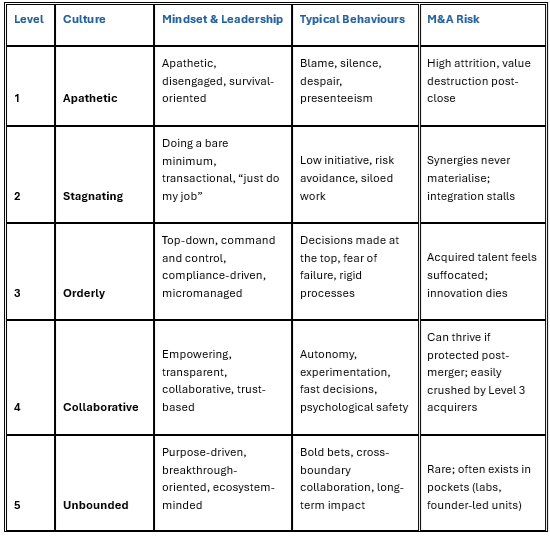
Figure 1. The 5 Levels of Culture: M&A Lens
Most successful SaaS companies operate primarily at Level 4, with pockets of Level 5 in product/R&D. Many large, legacy acquirers sit firmly at Level 3. This mismatch is where M&A value diminishes.
Case Study Analyses Through the 5-Level Lens of The Management Shift Framework
1. HP × Autonomy (2011) – $11.1 Billion Write-Down
The deal: HP (hardware giant) acquired Autonomy (UK enterprise software firm) for $11.1 billion to pivot into software.
Cultural profiles:
- HP: Predominantly Level 3 (Command & Control). Process-heavy, consensus-driven, risk-averse, public-company discipline.
- Autonomy: Predominantly Level 4 (Supportive & Entrepreneurial). Fast-moving, founder-led, opaque but highly autonomous, comfortable with ambiguity.
What happened: HP tried to impose Level 3 controls (reporting, compliance, decision gates) on a Level 4 organisation that thrived on speed and autonomy. Key Autonomy leaders disengaged, internal trust collapsed, and within a year HP took an $8.8 billion write-down, alleging accounting improprieties (disputed by Autonomy’s founders).
5-Level diagnosis:
- Clash: Level 3 acquirer suffocating a Level 4 target.
- Failure mode: Autonomy’s entrepreneurial behaviours were reclassified as “risky” or “non-compliant,” triggering defensiveness and exit of key talent.
- Missed shift: HP needed to learn from Autonomy’s Level 4 practices, not overwrite them. Instead, it tried to pull Autonomy down to Level 3.
Leadership lesson: When a Level 3 organisation acquires a Level 4 SaaS business, protect the target’s operating model. Use ring-fencing or reverse integration so Level 4 ways of working can influence the acquirer, not be crushed by it.
2. Microsoft × Nokia (2013) – $7.6 Billion Loss
The deal: Microsoft acquired Nokia’s Devices & Services division for $7.6 billion to accelerate its mobile strategy.
Cultural profiles:
- Microsoft (2013 era): Strongly Level 3 (Command & Control). Stack-ranking, internal competition, engineering-led, process-driven.
- Nokia: Mixed Level 3/4, leaning Level 4 in product teams. Hardware-first but with Finnish egalitarianism, consensus-based, strong craft culture.
What happened: Microsoft imposed its Level 3 performance management and decision processes on Nokia. Key Nokia talent left, product roadmaps conflicted, and integration stalled. Two years later, Microsoft wrote off the full $7.6 billion and cut 7,800 jobs, mostly from Nokia.
5-Level diagnosis:
- Clash: Level 3 acquirer imposing controls on a Level 4-leaning target.
- Failure mode: Nokia’s collaborative, craft-oriented culture was incompatible with Microsoft’s internal competition and top-down control.
- Missed shift: Microsoft needed a mindset and culture shift from Level 3 to Level 4 to unlock Nokia’s potential; instead, it doubled down on command-and-control.
Leadership lesson: In talent-centric M&A, the acquirer’s level sets the ceiling. If you are Level 3 and acquire Level 4 talent, expect attrition and value erosion unless you consciously shift your own leadership behaviours first.
3. Salesforce × Tableau (2019) – $15.7 Billion (Mixed Outcome)
The deal: Salesforce acquired data visualisation leader Tableau for $15.7 billion, one of the largest SaaS deals ever.
Cultural profiles:
- Salesforce: Primarily Level 4 (Supportive & Entrepreneurial). “Ohana” values, structured onboarding, strong purpose, but increasingly scaled and process heavy.
- Tableau: Strong Level 4, with pockets of Level 5. Product-led, designer-driven, autonomous, craft-oriented, experimentation-friendly.
What happened: Salesforce intentionally kept Tableau semi-autonomous, preserved its brand, and allowed its Level 4/5 culture to breathe. Early reports suggest this has been a relative success compared to typical mega-deals, though some friction exists over pace and decision rights as integration deepens.
5-Level diagnosis:
- Fit: Level 4 acquirer + Level 4/5 target.
- Success factor: Salesforce recognised Tableau’s Level 4/5 magic and protected it rather than forcing full assimilation.
- Risk: As Salesforce itself becomes more process-heavy (drifting toward Level 3 in some units), there is a risk of slowly eroding Tableau’s entrepreneurial edge.
Leadership lesson: When levels are aligned (4→4/5), light-touch integration can preserve the very capabilities you paid for. The goal is not uniformity, but compatible autonomy.
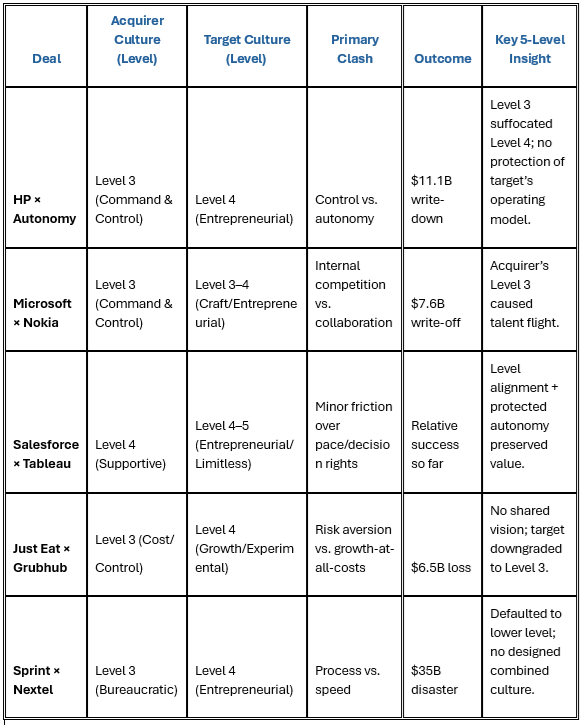
Table 2. SaaS M&A Culture Clashes Analysed via 5 Levels of The Management Shift framework
What SaaS Leaders Can Do Differently (Using the 5-Level Framework)
1. Make culture level part of diligence. Before LOI, assess:
- Where does each company sit on the 5-Level scale?
- Where are the pockets of Level 4/5?
- What specific behaviours (decision rights, risk tolerance, feedback styles) define those levels?
2. Define the target “combined level” explicitly. Not “Acquirer’s culture wins,” but:
“We are designing a Level 4+ combined company. Here are the behaviours we will keep from each side.”
3. Protect Level 4/5 pockets. If the target’s value is in its entrepreneurial or breakthrough culture, use:
- Ring-fenced units
- Separate operating models
- Reverse integration (let their practices influence you).
4. Plan a supported shift, not an imposed one. You cannot skip levels. If you need to move from Level 3 to Level 4, design a long term leadership and mindset shift, not a Day-1 policy change.
5. Measure cultural integration like a KPI. Track in the first 100 days:
- Retention of key Level 4/5 talent
- Employee psychological safety scores
- Time-to-decision on cross-company initiatives
- Number of experiments launched post-close
The Bottom Line
In SaaS M&A, you are not buying code, you are buying mindsets, behaviours, and ways of working. The 5-Level framework gives leaders a precise language to:
- Diagnose where each company truly operates
- Predict where friction will arise
- Design integration that elevates rather than erodes capability
Strategy tells you where to go. Culture level determines whether you can actually make the journey.
If you are leading or advising on a SaaS deal, ask the hard question early:
“What level are we really operating at, and what level do we need to be to make this deal work?”