Turning Culture into Value: Applying The Management Shift to M&A
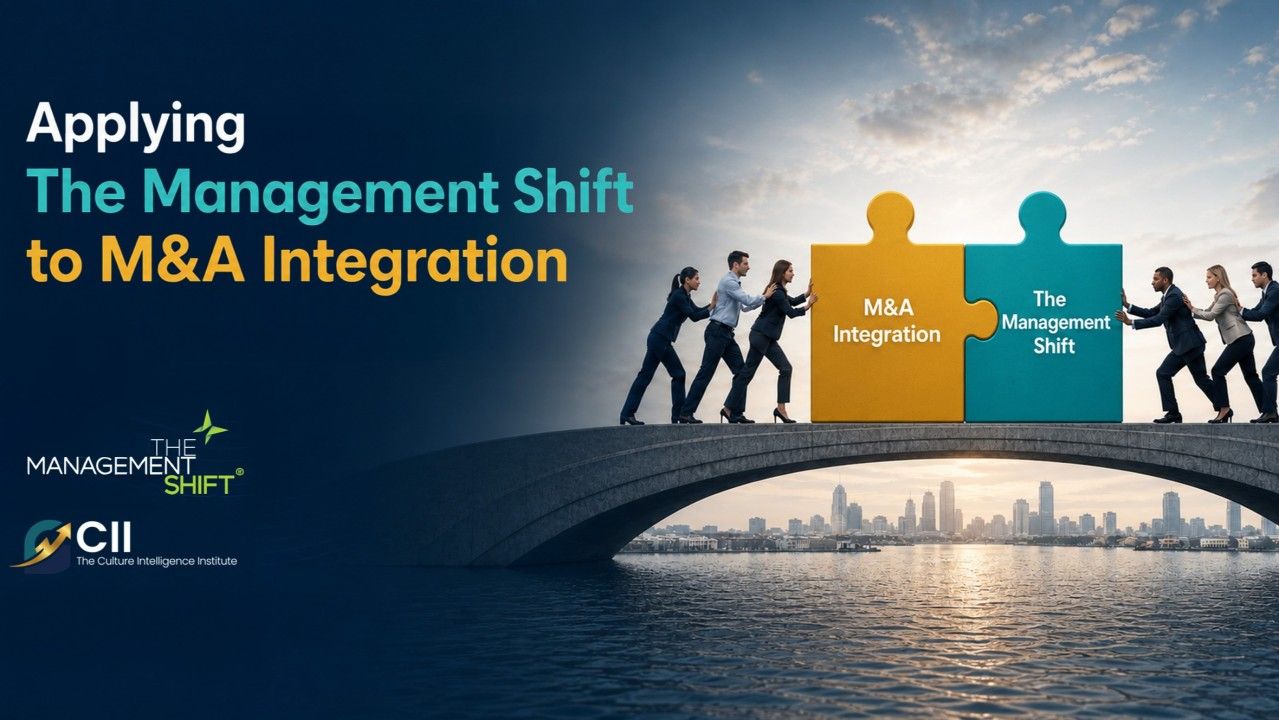
Mergers and acquisitions are often described as financial transactions, strategic plays, or operational combinations. The success or failure of a deal is shaped just as much by culture and leadership as by numbers on a spreadsheet.
That is where The Management Shift offers a powerful lens.
Its five levels provide a useful way to understand how an organisation behaves, transforms, makes decisions and responds to change. When applied to M&A, the model becomes more than a leadership framework. It becomes a practical tool for diagnosing the human dynamics that determine whether integration creates value or destroys it.
Why this matters in M&A
Too often, integration planning focuses on systems, governance, and reporting lines while overlooking the deeper question: how do people work together?
In a merger, two or more organisations are not only combining structures. They are bringing together different leadership styles, levels of trust, assumptions about authority, and cultural habits. If these are left unaddressed, the result is often predictable: hesitation, friction, poor decision-making, and talent loss.
The 5-Level Management Shift Model (framework) helps make those dynamics visible. Each level is described in the context of M&A below.
Level 1: Lifeless
At Level 1, the organisation is disengaged, passive, toxic and low in energy. People may comply, but they do not contribute with conviction. In an M&A setting, this can show up as anxiety, silence, and a general sense of waiting to see what happens next.
This is a dangerous starting point for integration because it creates inertia exactly when momentum is needed most. If leaders do not actively build trust and purpose, the combined organisation can quickly become flat and fragmented.
Level 2: Stagnating
Level 2 is characterised by people doing only a bare minimum. There may be activity, but little ownership. In an integration, this often appears as slow responses, limited initiative, and a reluctance to go beyond role boundaries.
This is especially problematic in M&A, where success depends on collaboration across legacy boundaries. If teams are operating at minimum effort, integration becomes a compliance exercise rather than a shared transformation.
Level 3: Orderly
At Level 3, leadership is top-down, decision-making is centralised, and processes are tightly managed. This can create clarity in the short term, but it often comes at the cost of flexibility, creativity, and engagement.
In M&A, this level is common when leaders feel pressure to impose order quickly. Yet over-control can easily deepen resistance, especially if one legacy organisation is seen as dominating the other. The result is often a “winner and loser” mindset that undermines trust and slows real integration.
Level 4: Collaborative
Level 4 is where organisations become more collaborative, accountable, entrepreneurial and adaptive. Teams take ownership,
leaders enable rather than simply direct, and there is greater energy around shared goals.
This is often the most effective operating level for integration. It allows leaders to create alignment without suppressing local initiative. It also encourages cross-functional problem-solving, which is essential when the new organisation needs to move quickly while building a shared identity.
For M&A, Level 4 is where integration begins to feel real. People are not just surviving change; they are helping shape it.
Level 5: Unbounded
Level 5 represents an organisation that is highly innovative, purpose-led, and capable of continuous reinvention. It is not simply efficient; it is transformational.
In M&A, this is the most ambitious outcome. It means creating not just a larger organisation, but a better one. A combined business operating at this level does more than preserve value, it generates new value through imagination, trust, and bold leadership.
This is where the merger becomes a platform for future growth rather than a compromise between legacy models.
Table 1 summarises application of the 5-Level Management Shift Model to M&A, which is especially useful for culture diligence and integration work.
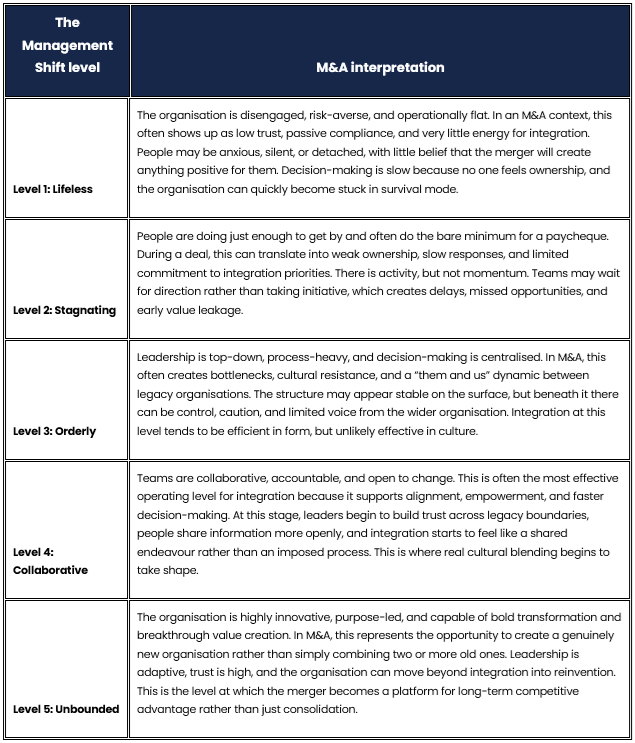
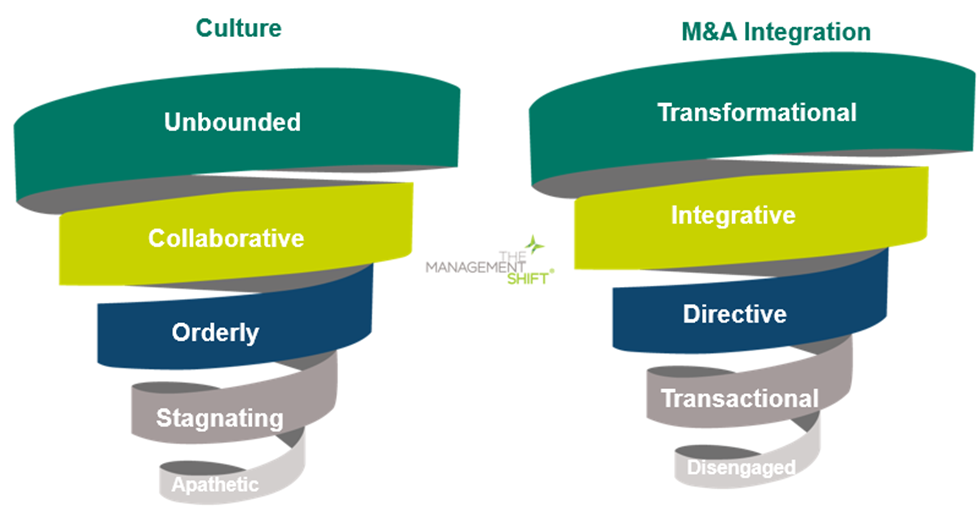
Figure 1 shows mapping of M&A integration to the 5-Level Management Shift Model.
What leaders should look for
The value of mapping The Management Shift to M&A is that it gives leaders a language for diagnosing culture beyond vague impressions. It helps answer questions such as:
- Are people merely complying, or are they genuinely committed?
- Is leadership enabling collaboration, or reinforcing control?
- Are we integrating two or three organisations, or simply layering one structure over another?
- Do we have a shared ambition for the future, or only a shared transaction?
These are not soft questions. They are strategic ones.
Culture as a value driver
The most successful deals are not just financially sound. They are culturally coherent.
When leaders understand the behavioural level at which the organisation is operating, they can design interventions that move it forward. That may mean building trust, clarifying decision rights, opening up communication, or creating space for shared ownership.
In this sense, The Management Shift becomes more than a model. It becomes a guide to value creation.
Moving from integration to transformation
M&A should not be judged only by whether the deal closes or the systems migrate successfully. It should also be judged by whether the combined organisation becomes more capable, more aligned, and more future-ready than either legacy business was alone. That is the real challenge.
The five levels of The Management Shift Model offer a simple but powerful reminder: integration is not just about combining assets. It is about shifting the way people think, lead, and work together. And when that shift is done well, M&A becomes more than consolidation. It becomes transformation.
#MergersAndAcquisitions #LeadershipDevelopment #CultureIntegration #OrganisationalHealth #ManagementShift #ChangeManagement #ValueCreation #ExecutiveLeadership #PostMergerIntegration #OrganisationalCulture