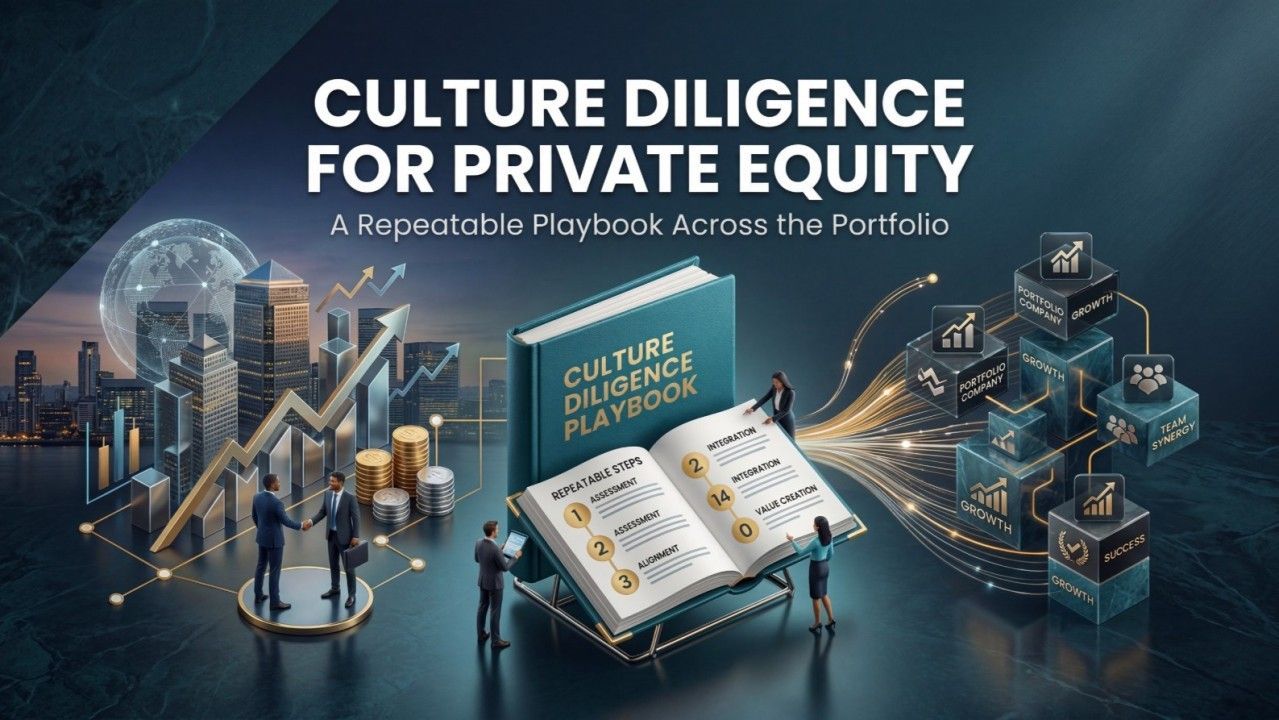
Culture Diligence for Private Equity: A Repeatable Playbook Across the Portfolio
For years, PE value creation has focused on financial engineering, cost optimisation and commercial synergies. But in platform and add‑on strategies, the real execution risk sits in one place: how people decide, collaborate and lead once the deal closes. That is culture, and it can be measured, managed and scaled.
At the Culture Intelligence Institute, we work with investors to turn culture from a one‑off, anecdotal observation into a standardised, repeatable diligence process that can be applied to every platform and every bolt‑on.
Step 1: A Standard Culture Diligence Spine for Every Deal
Instead of reinventing the wheel, leading PE firms are supported by the same core culture diligence sequence on each transaction:
- Rapid leadership and culture hypothesis based on the investment thesis
- Organisational Health Scan (OHS) deployed as a 20‑minute, zero‑disruption diagnostic
- Structured interviews and “human risk” review integrated into the IC pack
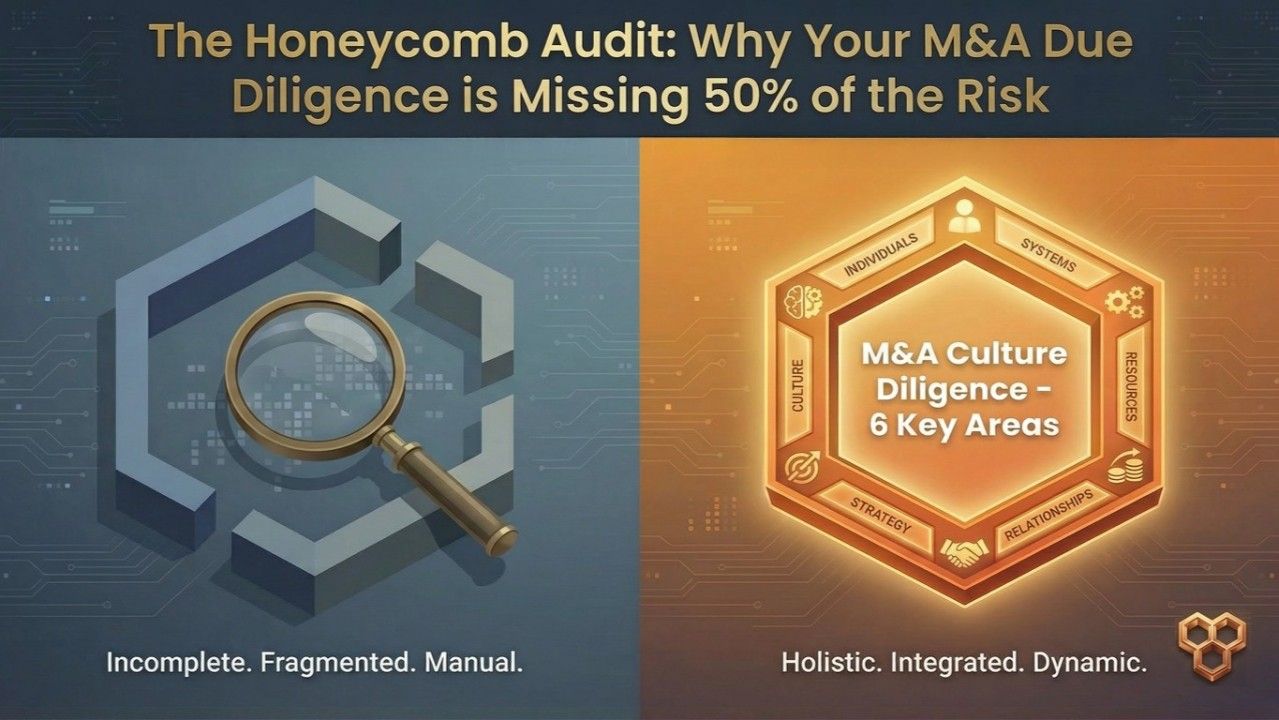
The Organisational Health Scan quantifies what we call Culture Capital: the real, human execution capacity of the business across six predictive value drivers and indicators of M&A success: Culture, Relationships, Individuals, Strategy, Systems and Resources. That means every deal benefits from comparable data, not just gut feel.
You can learn more about the OHS approach here: https://www.managementshiftsolutions.com/OHSScan and about our broader culture diligence work at: https://www.cultureintelligenceinstitute.com
Step 2: Using OHS Data to Choose: Integrate, Federate or Leave Autonomous
Once culture and leadership are measured, the core integration question becomes strategic: Is this an asset we fully integrate, federate, or deliberately keep autonomous?
- Integrate: When OHS shows high alignment on strategy, decision‑making and trust, it may be safe to move quickly to a common operating model and systems.
- Federate: When the target has a strong Level 4 culture (high trust, collaboration, innovation) that the platform lacks, the right move is often to preserve and learn from it, not to standardise it away.
- Autonomous: When the target’s value comes from a distinct niche, brand or culture, OHS data often supports a “light‑touch” integration, with shared governance but minimal cultural interference.
Because the OHS provides both quantitative scores and deep qualitative feedback, deal teams can defend these choices in IC discussions, rather than arguing from intuition alone. Further explanation of these integration strategies is shown in Figure 1 below.
Step 3: Case‑Style Narratives: How Early Culture Diagnostics Change Outcomes
Across the portfolio, a repeatable culture diligence playbook enables investors to:
- Spot Execution Friction before it hits EBITDA: low trust between functions, leadership misalignment, toxic subcultures, change fatigue.
- Protect and scale Level 4/5 pockets (using The Management Shift framework) instead of suffocating them under Level 3 bureaucracy.
- Build a differentiated exit story: not just financial performance, but a demonstrably stronger, more scalable organisational operating system.
For example, we have seen early OHS insights lead investors to:
- Adjust integration speed and sequencing, preventing the loss of a high‑performing team.
- Change the planned leadership structure when data showed a hidden “culture carrier” critical to execution.
- Reframe the value creation plan around trust, collaboration and psychological safety metrics that buyers later viewed as major de‑risking factors.
In each case, culture diligence did not replace traditional PE rigour; it made it repeatable and safer, deal after deal.
Integration options grounded in OHS data
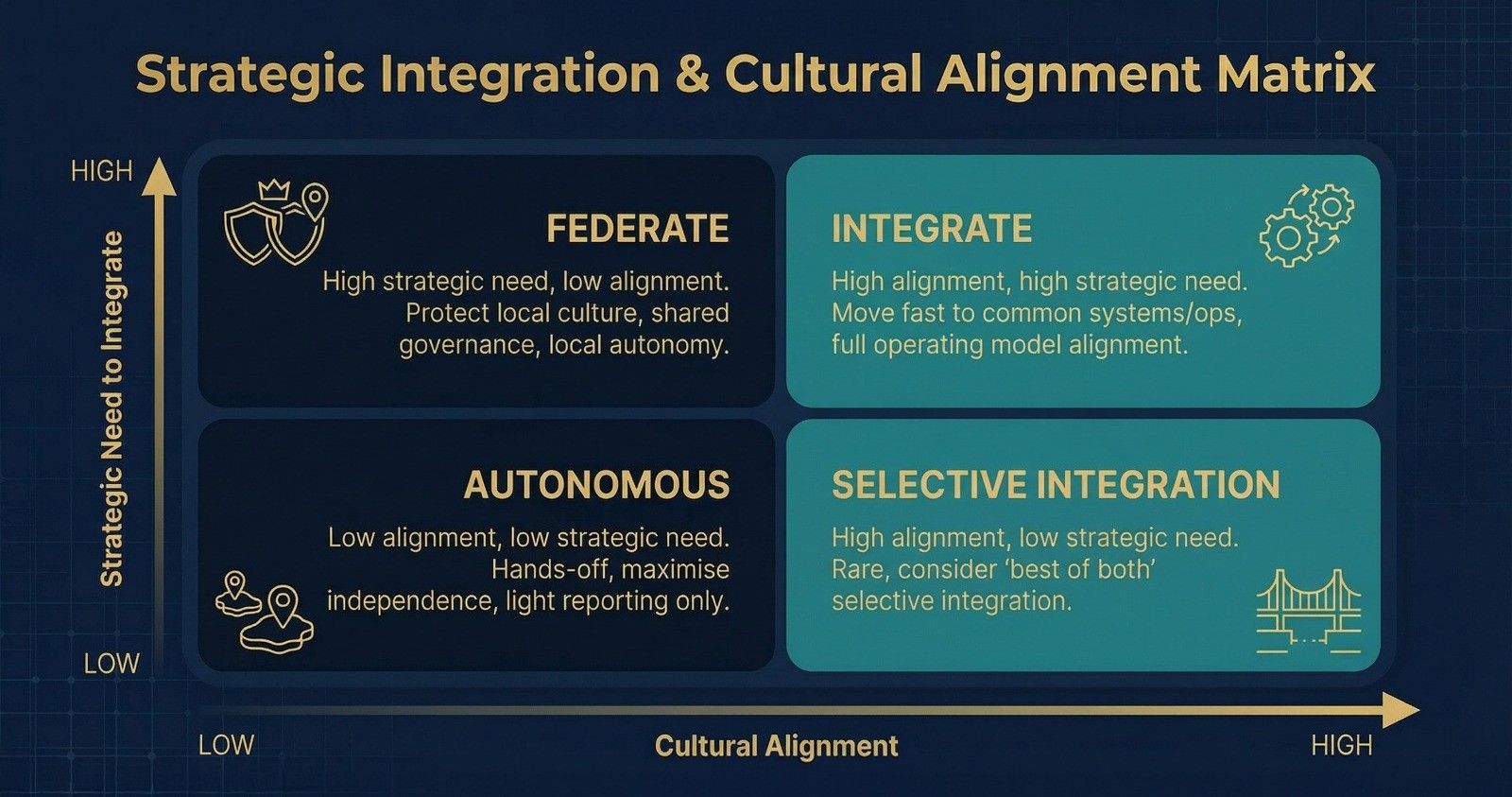
- Top‑Right (Integrate): High alignment + high strategic need = move fast to common systems/ops
- Top‑Left (Federate): High strategic need but low alignment = protect local culture, federated model
- Bottom‑Left (Autonomous): Low alignment + low strategic need = hands‑off, maximise independence
- Bottom‑Right (Selective Integration): High alignment + low strategic need = rare, but consider "best of both" selective integration
OHS Data tells you exactly where each bolt‑on plots, with no guesswork and repeatable decisions across the portfolio.
For PE firms serious about buy‑and‑build, the question is no longer “Should we look at culture?” but: “What is our standard culture diligence playbook, and how fast can we apply it across the portfolio?”