6 Key Questions to Quantify the Culture Variable and Secure M&A Value
(c) 2026 Management Shift Solutions
During my recent briefings with Private Equity boards and M&A leads, a consistent theme emerged: How do we turn the "soft" culture variable into "hard" data?
Most M&A deals look flawless on a spreadsheet, yet 70–90% underperform in the hallway. The variable causing this value erosion is not found in the tax returns; it is found in the culture operating system of the companies involved.
These are the 6 strategic questions currently defining the discourse on deal value.
1. Integration Strategy: When to Protect and When to Merge
The Question: If we had a quantified Organisational Health Scan (OHS), what specific decisions regarding integration would we make differently?
The data dictates the architecture. One of the most dangerous assumptions in M&A is that "Integration" must mean "Standardisation."
If the data reveals a Level 3 Acquirer (Bureaucratic, rules-driven) and a Level 4 Target (Agile, trust-based, innovative), based on the (5-Level) Management Shift framework, a standard integration will likely destroy the very asset you just bought.
The Strategic Shift: In this scenario, the move is "Reverse Integration" or "Protective Ring-Fencing." Much like Disney’s acquisition of Pixar, the goal is to protect the target’s high-performance culture from being suffocated by the acquirer’s bureaucracy. You do not just merge; you design an interface that preserves the innovation engine.
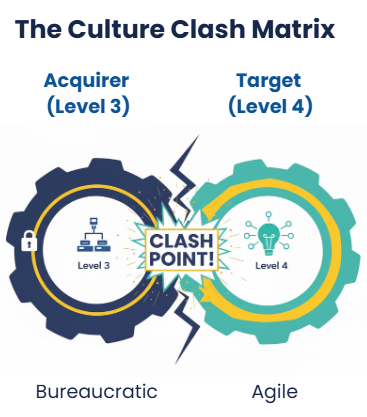
Figure 1. The Culture Clash Matrix
2. The Day 1 Regret: The Danger of "Flexibility"
The Question: Which cultural choice do acquirers try to keep flexible, but later regret not locking on Day 1?
Acquirers often try to play it safe by staying "flexible" on operational culture to avoid upsetting the new team. This is a mistake.
The Regret: By failing to "lock in" a strategy to protect the target’s unique innovative behaviors on Day 1, the dominant culture (usually the larger, slower one) naturally begins to suffocate the smaller, faster one.
The result is immediate Key-Person Risk. The talent that created the value sees the creeping bureaucracy, feels the loss of autonomy, and exits. You cannot leave the protection of your "Agile Asset" to chance; it must be a Day 1 priority.
3. Securing Board Buy-In: Culture as a Financial Liability
The Question: What would it take for an Investment Committee to view culture intelligence as mandatory?
Boards do not move on "vague feelings," but they do move on Risk Mitigation.
To get board buy-in, you must stop presenting culture as an HR exercise and start presenting it as a Quantifiable Liability. When you show the board that cultural clashes have led to massive write-downs, such as the $7.6B loss in the Microsoft/Nokia deal, the conversation shifts.
Culture due diligence is not just about "making people more engaged and happy", it is about identifying Execution Risk that could erode the investment thesis.
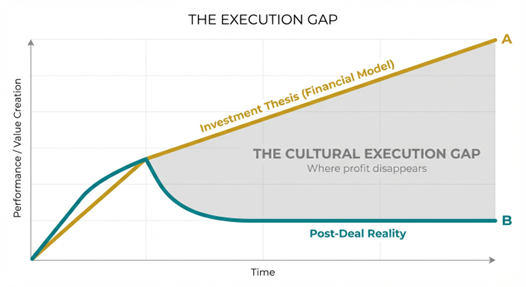
Figure 2. The Execution Gap
4. The Anatomy of Value Erosion
The Question: Which clashes most visibly erode deal value post-close?
The most destructive clash is between Command-and-Control (Level 3) and Collaborative Innovation (Level 4).
When a Level 3 firm imposes strict hierarchy and multi-layered approval processes on a Level 4 firm, the "Agile Asset" effectively breaks. Innovation stops, momentum dies, and the ROI evaporates. This is a predictable mechanical failure of the organisation's culture.
5. The Triggers: When do Leaders call us?
The Question: What is the trigger for a company to seek a cultural diagnostic?
We typically see four commercial triggers:
● Proactive Diligence: Sophisticated leaders who want to quantify risk before the signature.
● Pre-Exit Growth: CEOs looking to maximise valuation and "exit readiness" 12–18 months before a sale.
● Reactive Intervention: When the deal is signed but the integration is stalling and talent is leaving.
● Investor Mandate: PE firms requiring a "Human Capital Audit" as a condition of investment.
M&A Value Lifecycle
See content credentials

Figure 3. The Strategic Timing Gap Map
6. The Competitive Edge: Why the OHS is the New M&A Standard
The Question: How does the OHS approach differ from other human capital diagnostic surveys or scans?
In the context of M&A, speed to value is everything. You do not need an academic study, you need an Integration Architecture.
Beyond the Mechanical: While other well-known firms focus on structure, we focus on the 6 key drivers of organisational success. You can change an organisational chart in a day, but you cannot change an "Operating System" without addressing the 6 keys areas, including culture.
Beyond the Top-Down: Standard PE "Human Capital" approaches focus only on the "Driver" (the CEO). We focus on the "Vehicle" (the organisation) using Viral Change to ensure the entire company can execute at pace.
Diagnosis vs. Cure: Competitors often provide a "Report Card" (a snapshot of current health). We provide the roadmap and the specific "Shift" methodology required to move a target from stagnation to high-performance.
The OHS Framework: 6 Predictive Indicators of Synergy Realisation
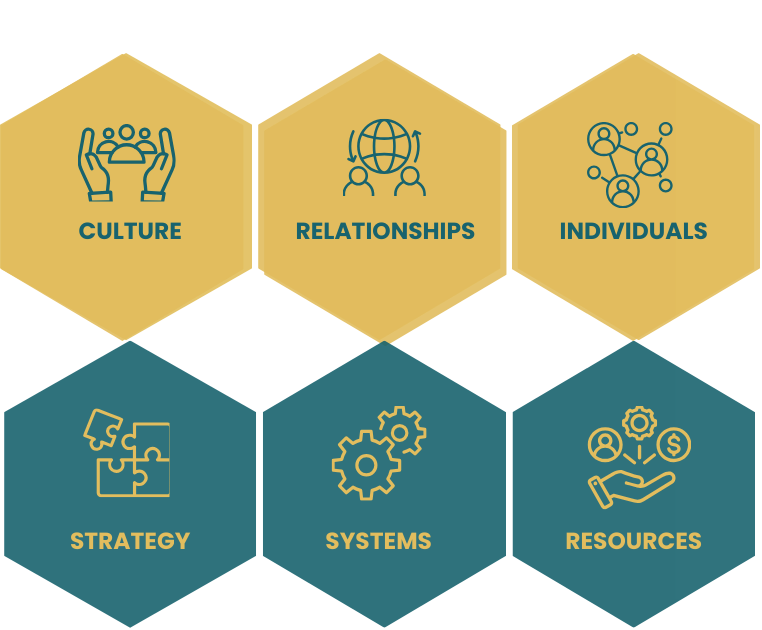
Figure 4. Six drivers of value creation measured by the Organisational Health Scan diagnostics
The Speed of Diligence
A common concern is that culture assessment will slow the deal. Using the Organisational Health Scan (OHS), the data collection phase takes roughly two weeks.
In the time it takes to finish your legal review, you could have a complete "Red Flag" report on the execution capacity of your target.
Do not leave your investment thesis to chance. If you are not measuring the culture, you are not seeing the whole deal.
Quantify the "Human Risk" Traditional Diligence Misses
Secure a Complimentary Leadership Risk Diagnostic and receive a sample bespoke executive briefing report with key insights for up to six leaders, plus a private strategy call to interpret your results.
Click here to schedule your briefing: https://www.cultureintelligenceinstitute.com/webinar
Professor Vlatka Ariaana Hlupic, Award-winning CEO & Founder, The Culture Intelligence Institute www.cultureintelligenceinstitute.com