The Culture Capital Multiplier: Engineering Top Quartile M&A Returns in 100 Days

Vlatka Hlupic • March 2, 2026
Handshake with upward arrow, puzzle pieces, text:

(c) 2026 Management Shift Solutions

The ink on the contract is dry. The financial models project exceptional returns. For elite acquirers, the first one hundred days post close are not a period of risk mitigation: they are a critical window for aggressive synergy acceleration.


While average deals stall in the hallway, top quartile firms use this exact phase to lock in execution capacity and multiply deal value. Research proves that deals with active culture management are 40% more likely to meet or exceed their synergy targets. You have bought a high-performance asset: now you must engineer the environment for it to thrive.


The Anatomy of Value Creation


The first one hundred days dictate whether a deal will achieve its full potential or suffer from execution friction. The primary advantage for top tier Private Equity investors and CEOs is a rigorous strategy regarding the human variable.


Financial and operational integrations are meticulously planned, and the integration of the organisational operating system must be treated with the exact same commercial rigour. When a Level 3 (bureaucratic acquirer) intentionally empowers a Level 4 (agile target) based on The Management Shift framework, the resulting alignment accelerates the investment thesis.


Hope is not a strategy. You cannot secure the first one hundred days with observation alone. To protect capital and optimise strategic upside, leaders require a rigorous and proven methodology to quantify execution capacity.


The Solution: The Culture Intelligence Toolkit Suite


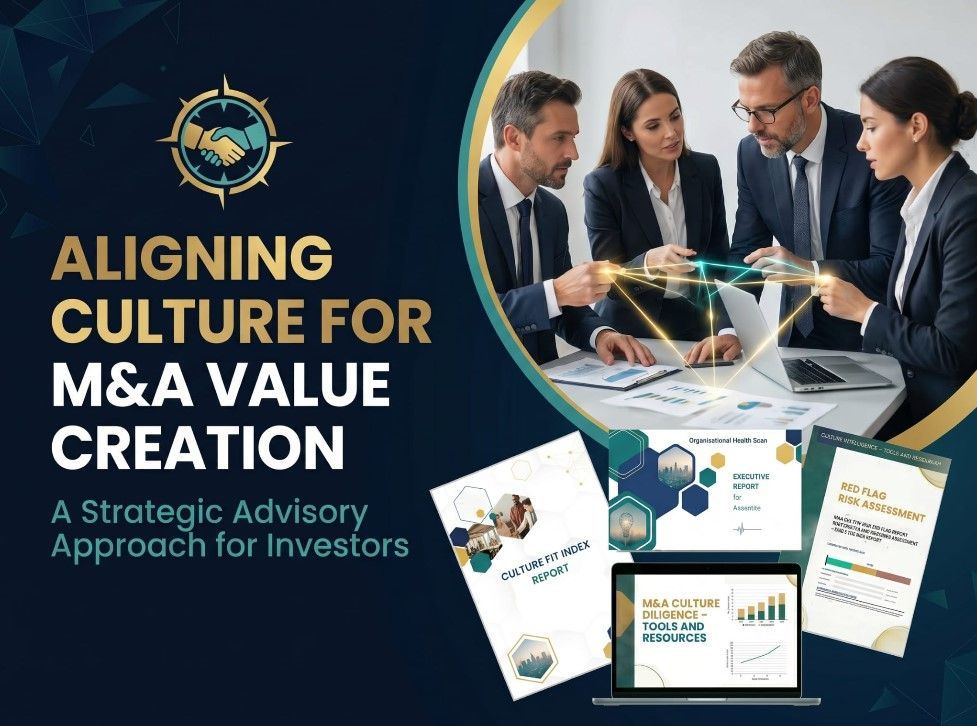
At The Culture Intelligence Institute, we provide the exact architecture required to transition from stabilisation to momentum. Our comprehensive Culture Intelligence Toolkit Suite equips deal teams with the precise instruments needed to secure the first one hundred days and drive EBITDA growth.


This suite integrates three powerful assets to turn soft integration concepts into hard performance data:


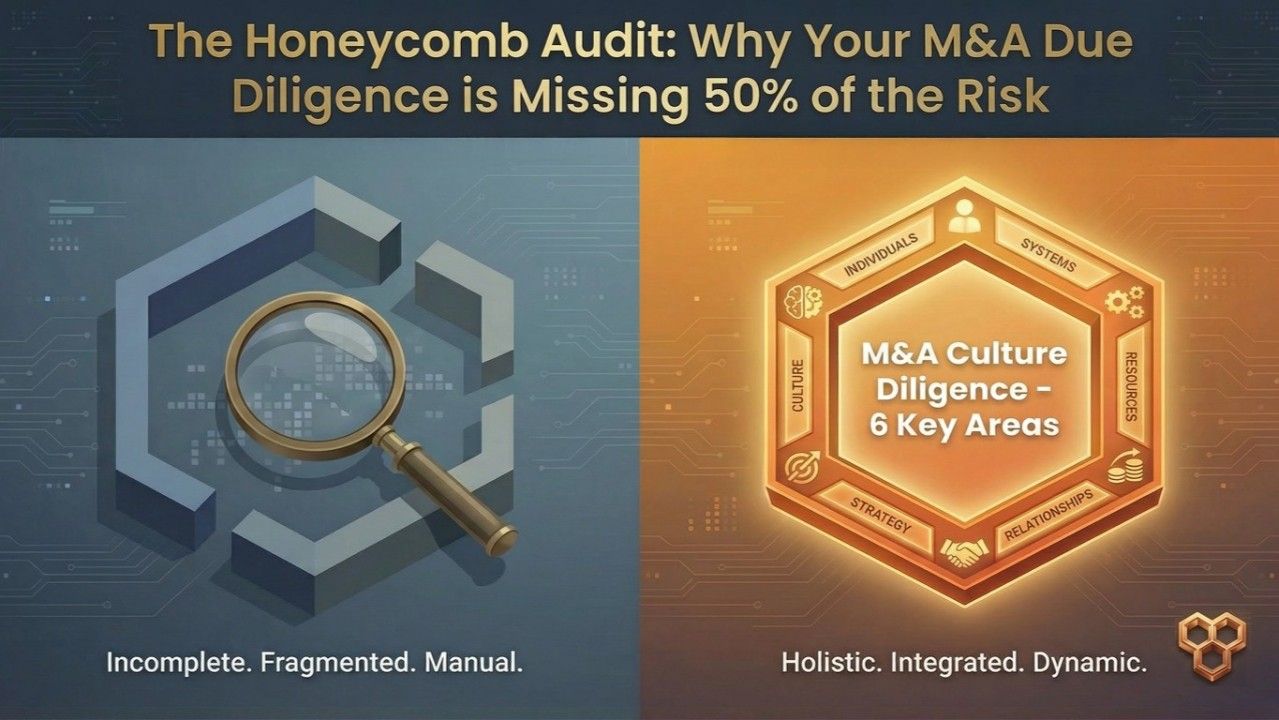
1. The Diagnostic Engine: The Organisational Health Scan (OHS) The core of the suite is the OHS. It is an MRI of the present. It captures the current level of the key value drivers in 15-20 minutes, providing real time human truth rather than relying on historical, incomplete data. By measuring the six predictive indicators of M&A success (Culture, Relationships, Individuals, Strategy, Systems, and Resources), the OHS provides the exact data required to build a flawless integration architecture.


2. The Execution Framework: The 100 Day Acceleration Roadmap The insights generated by the OHS directly power our commercial roadmap.


● Phase 1 Diagnose (Days 1 to 30): We deploy the OHS to establish a quantifiable baseline of execution capacity. The scan identifies immediate value drivers, isolates operational bottlenecks, and pinpoints the exact cultural and leadership levers required to accelerate the deal model.


Phase 2 Align (Days 31 to 60): We facilitate high impact leadership workshops using the precise OHS data to bridge the gap between the buyer and target operating models. By agreeing on a unified culture, we ensure the executive team is aligned around a single value creation plan.


● Phase 3 Execute (Days 61 to 100): We roll out the unified culture plan. By tracking behavioural KPIs established by the OHS alongside financial synergies, we ensure the organisation has the velocity required to deliver the promised EBITDA uplift.


3. The Preliminary Assessment: The M&A Culture Risk Audit and Checklist To successfully navigate this critical period, deal teams must first identify their baseline position. The foundational asset of our suite is the Culture Risk Checklist and Red Flag Risk Assessment. These resources allow you to identify immediate cultural red flags and prepare your deal team for a full Organisational Health Scan deployment.


A Preview of the Culture Risk Audit: 3 Indicators of Execution Friction


To understand the commercial rigour of our methodology, consider these three observable indicators from our Culture Risk Audit. If you observe these behaviours during diligence or early integration, your investment thesis is already at risk:


Key Person Dependency: Does the target CEO answer more than 80 percent of questions during management presentations, even when functional heads are present? (Indicates low scalability and high exit risk).

Execution Disconnect: Can middle management clearly articulate the three-year growth goal without referencing a slide deck? (Indicates strategic fog and a lack of alignment).


Silo Friction: Do legacy departments refer to each other as partners, or do they use adversarial terms like "The Blockers" or "They"? (Indicates severe synergy realisation risk).


If your deal team cannot confidently answer these questions, you are operating with a critical blind spot.


Equip Your Team for Day 1


Do not leave your investment thesis to chance. If you are not measuring the culture with a rigorous diagnostic, you are not seeing the whole deal. We provide the data led architecture to ensure your organisation is actually capable of delivering the synergies you have promised the board.


I am delighted to share the entry point to our Culture Intelligence Toolkit Suite. Access the preliminary assessment today and take the first step toward top quartile performance.


Download the M&A Culture Risk Audit   and Checklist Here or Book a One-to-One Session   to learn more about the   OHS scan and/or 100 day roadmap.


Professor Vlatka Ariaana Hlupic.
By Vlatka Hlupic April 14, 2026
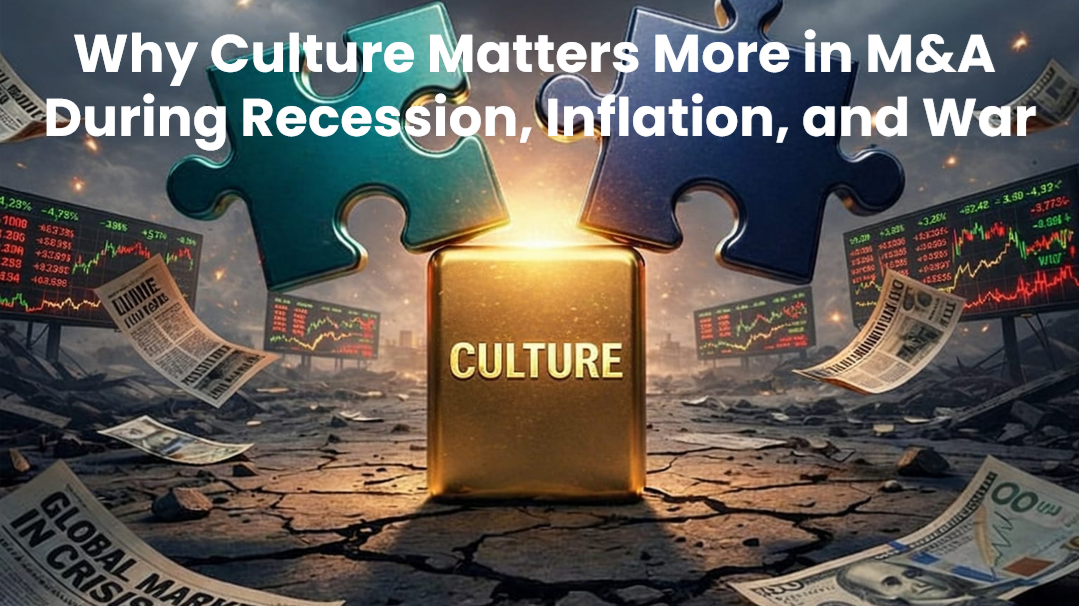
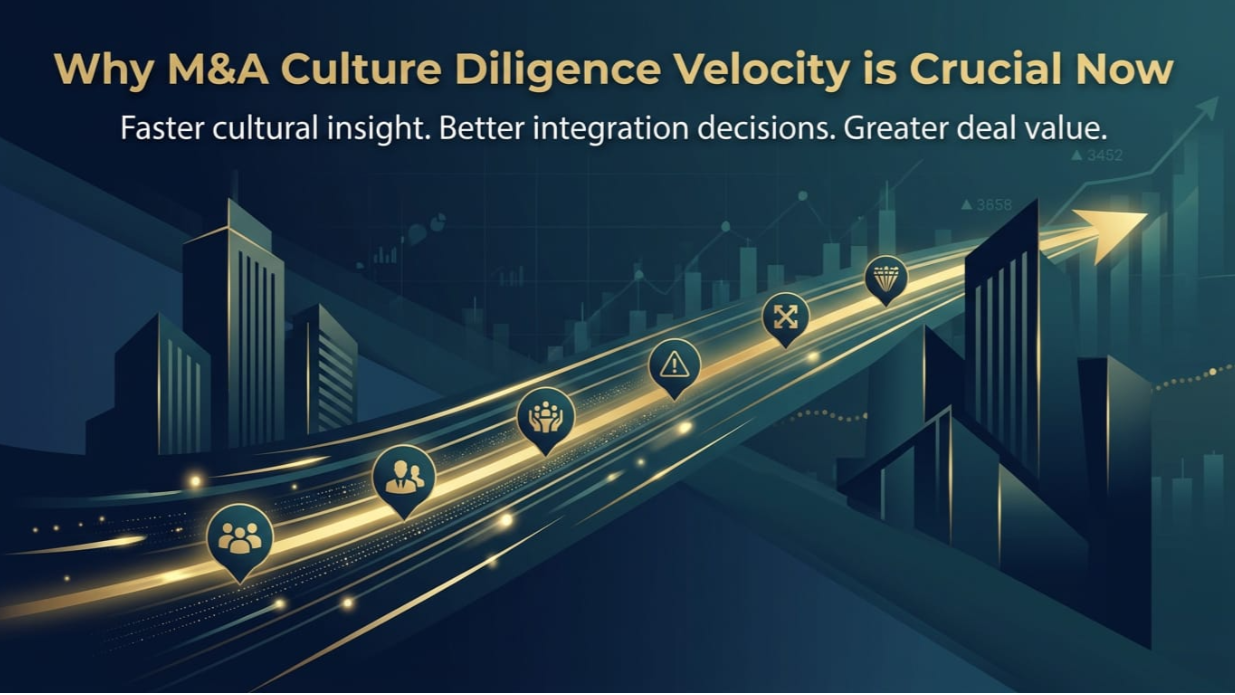
In good times, M&A is often sold as a story of growth, expansion, and synergy. Cultural friction can be overlooked when markets are strong, bonuses are high, and confidence is rising. But in times of recession, inflation, or war, the picture changes fast. The economy becomes a stress test for corporate culture, revealing how organisations really behave under pressure. When uncertainty rises, M&A is no longer just about scale or market position. It becomes a test of resilience, trust, psychological safety, and leadership judgement. Recessions: Survival mode In a recession, M&A often shifts from growth to consolidation, cost synergies, or distressed acquisitions. That changes the cultural dynamic immediately. A common risk is the “conqueror versus conquered” mindset. A stable acquirer may unconsciously signal, “we saved you,” which can create resentment and damage trust. Recessions also bring fear of layoffs, which leads to defensiveness, information hoarding, and self-preservation. Instead of collaboration, people protect their own position. For buyers, the key question becomes: can this organisation stay resilient under pressure ? Inflation: Scarcity mode Inflation creates a different kind of pressure. Margins tighten, costs rise, and employees feel the squeeze personally. This is where pay disparities and fairness issues become explosive. If one company protects salaries while the other cuts back, resentment can build quickly. Inflation also exposes weak culture. If a business relied on perks rather than purpose, those benefits disappear fast once budgets tighten. At the same time, inflation pushes leaders into short-term thinking. That can clash with a target that is built around long-term innovation and investment. War and geopolitical instability: Values mode War and geopolitical tension add a deeper layer of complexity to M&A. Companies increasingly think in terms of nearshoring and friend shoring, which makes political alignment part of the deal conversation. Psychological safety also becomes critical. Employees want to know whether leadership will protect them, communicate clearly, and act with empathy.  War forces hard ethical choices too. If one company is purpose-driven and the other is purely profit-driven, culture conflict can surface fast after the deal closes. The crucible effect Crises can also strengthen integration. Organisational psychologists call this the crucible effect. Shared adversity can break down silos and accelerate bonding, but only if leadership is transparent, honest, and human. Handled well, pressure can create unity. Handled poorly, it can destroy trust. How the Organisational Health Scan helps In volatile markets, the biggest M&A risks are often human, not financial. Anxiety rises, trust becomes fragile, and employees quickly notice whether leadership is clear, fair, and empathetic. This is where the Organisational Health Scan from the Culture Intelligence Institute becomes especially valuable. It helps leaders spot cultural strengths, surface hidden risks, and identify where friction and misalignment are likely to emerge during integration. That means issues such as low psychological safety, unclear decision-making, or poor communication can be addressed early. Used well, it becomes a navigation system for post-merger integration, helping leaders move from reactive damage control to proactive culture building that will lead to higher returns. Summary In normal times, culture in M&A is about alignment. In times of recession, inflation, and war, culture in M&A is about resilience, empathy, and psychological safety. The best M&A leaders understand this: culture is not a soft issue. In uncertain times, it is the operating system that determines whether the deal creates lasting value or collapses under pressure. #MergersAndAcquisitions #M&A #CorporateCulture #Leadership #PostMergerIntegration #Resilience #PsychologicalSafety #Strategy #OrganisationalHealth #Culture
By Vlatka Hlupic April 9, 2026
In SaaS, M&A is often sold as a shortcut to scale, capability, or market dominance. Yet deal after deal shows that the biggest risk is not the technology, the TAM, or even the price, it is culture. Using the 5 Levels of Culture from The Management Shift framework (see Figure 1), we can move beyond vague “culture fit” conversations and diagnose exactly where and why these deals fractured.
The Honeycomb Audit: Why Your M&A Due Diligence is Missing 50% of the Risk
By Vlatka Ariaana Hlupic April 1, 2026
The Honeycomb Audit: Why Your M&A Due Diligence is Missing 50% of the Risk
By Vlatka Ariaana Hlupic March 29, 2026
For years, PE value creation has focused on financial engineering, cost optimisation and commercial synergies. But in platform and add‑on strategies, the real execution risk sits in one place: how people decide, collaborate and lead once the deal closes. That is culture, and it can be measured, managed and scaled. At the Culture Intelligence Institute, we work with investors to turn culture from a one‑off, anecdotal observation into a standardised, repeatable diligence process that can be applied to every platform and every bolt‑on. Step 1: A Standard Culture Diligence Spine for Every Deal Instead of reinventing the wheel, leading PE firms are supported by the same core culture diligence sequence on each transaction: Rapid leadership and culture hypothesis based on the investment thesis Organisat ional Health Scan (OHS) deployed as a 20‑minute, zero‑disruption diagnostic Structured interviews and “human risk” review integrated into the IC pack The Organisational Health Scan quantifies what we call Culture Capital: the real, human execution capacity of the business across six predictive value drivers and indicators of M&A success: Culture, Relationships, Individuals, Strategy, Systems and Resources. That means every deal benefits from comparable data, not just gut feel. You can learn more about the OHS approach here: https://www.managementshiftsolutions.com/OHSScan and about our broader culture diligence work at: https://www.cultureintelligenceinstitute.com Step 2: Using OHS Data to Choose: Integrate, Federate or Leave Autonomous Once culture and leadership are measured, the core integration question becomes strategic: Is this an asset we fully integrate, federate, or deliberately keep autonomous? Integrate: When OHS shows high alignment on strategy, decision‑making and trust, it may be safe to move quickly to a common operating model and systems. Federate: When the target has a strong Level 4 culture (high trust, collaboration, innovation) that the platform lacks, the right move is often to preserve and learn from it, not to standardise it away. Autonomous: When the target’s value comes from a distinct niche, brand or culture, OHS data often supports a “light‑touch” integration, with shared governance but minimal cultural interference. Because the OHS provides both quantitative scores and deep qualitative feedback, deal teams can defend these choices in IC discussions, rather than arguing from intuition alone. Further explanation of these integration strategies is shown in Figure 1 below. Step 3: Case‑Style Narratives: How Early Culture Diagnostics Change Outcomes Across the portfolio, a repeatable culture diligence playbook enables investors to: Spot Execution Friction before it hits EBITDA: low trust between functions, leadership misalignment, toxic subcultures, change fatigue. Protect and scale Level 4/5 pockets (using The Management Shift framework) instead of suffocating them under Level 3 bureaucracy. Build a differentiated exit story : not just financial performance, but a demonstrably stronger, more scalable organisational operating system.  For example, we have seen early OHS insights lead investors to: Adjust integration speed and sequencing, preventing the loss of a high‑performing team. Change the planned leadership structure when data showed a hidden “culture carrier” critical to execution. Reframe the value creation plan around trust, collaboration and psychological safety metrics that buyers later viewed as major de‑risking factors. In each case, culture diligence did not replace traditional PE rigour; it made it repeatable and safer, deal after deal. Integration options grounded in OHS data
When Spreadsheets Fail: Protecting Level 4 Mindset from Level 3 Bureaucracy in M&A
By Vlatka Hlupic March 23, 2026
When Spreadsheets Fail: Protecting Level 4 Mindset from Level 3 Bureaucracy in M&A
The Hidden Cost of Talent Flight in M&A
By Vlatka Ariaana Hlupic March 18, 2026
The Hidden Cost of Talent Flight in M&A
The Culture Capital Equation: Combining Quantitative Data with Executive Intuition
By Vlatka Hlupic March 10, 2026
Most mergers and acquisitions look flawless on a spreadsheet, yet they frequently underperform in the hallway. They treat the organisational operating system as a measurable, highly valuable asset. We call this Culture Capital.
By Professor Vlatka Ariaana Hlupic February 26, 2026
(c) 2026 Management Shift Solutions
By Professor Vlatka Ariaana Hlupic February 23, 2026
(c) 2026 Management Shift Solutions
Diagram showing
By Professor Vlatka Ariaana Hlupic February 3, 2026
The 5 Levels of The Management Shift: A Practical Framework for Culture Diligence in M&A