The Culture Capital Equation: Combining Quantitative Data with Executive Intuition

Most mergers and acquisitions look flawless on a spreadsheet, yet they frequently underperform in the hallway. To achieve top quartile returns, elite acquirers recognise that financial engineering alone is insufficient. They treat the organisational operating system as a measurable, highly valuable asset. We call this Culture Capital.
Accurately measuring and leveraging Culture Capital, however, requires a precise formula. When deal teams attempt to evaluate the human variable during due diligence or post deal integration, they typically fall into one of two dangerous extremes: subjective observation or automated data scraping. To secure the investment thesis and accelerate synergy realisation, leaders must employ the Culture Capital Equation combining rigorous qualitative and quantitative data with executive brainstorming, commercial strategy and executive intuition.
The Flaw of Extremes in Culture Diligence
The Subjective Trap
Historically, deal teams have relied on gut feel and management presentations to assess cultural alignment. This approach is highly vulnerable to observation bias. Target leadership teams are on their best behaviour during diligence. Subjective estimation cannot predict Execution Friction, nor can it identify the hidden Cultural Liabilities that will eventually erode deal value.
The Artificial Intelligence Fallacy
In response to the flaws of subjective observation, many firms have pivoted entirely to automated tools. These systems scrape emails, communication platforms, and digital footprints to generate sentiment scores. However, such tools rely entirely on historical metadata. They are an autopsy of the past. They cannot read the room, they cannot detect the unwritten rules of the organisational culture, and they are completely blind to the Shadow Culture that dictates how work actually gets done.
The Culture Capital Equation
To protect your capital and optimise strategic upside, you must bridge the gap between raw data and human reality. The Culture Capital Equation is straightforward but highly rigorous:
Quantitative Data + Qualitative Feedback + Commercial Strategy + Executive Intuition = Execution Capacity
At The Culture Intelligence Institute, we operationalise this equation to construct a precise Integration Architecture for our clients.
Step 1: Securing Real Time Human Truth
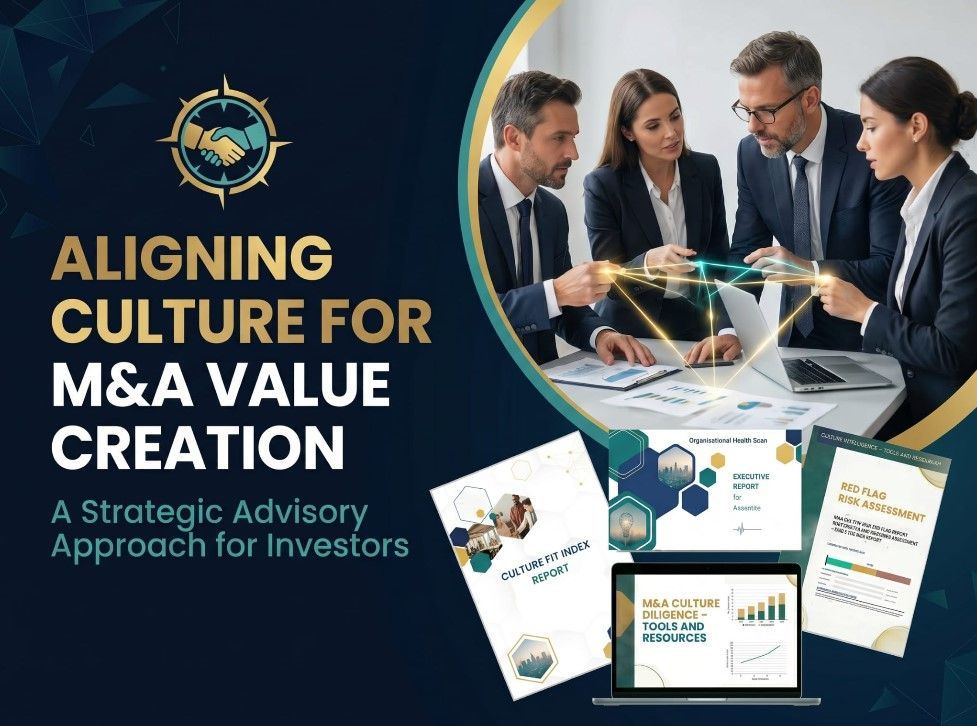
The foundation of the equation is the Organisational Health Scan (OHS). Unlike tools that guess based on history, the OHS functions as an MRI of the present.
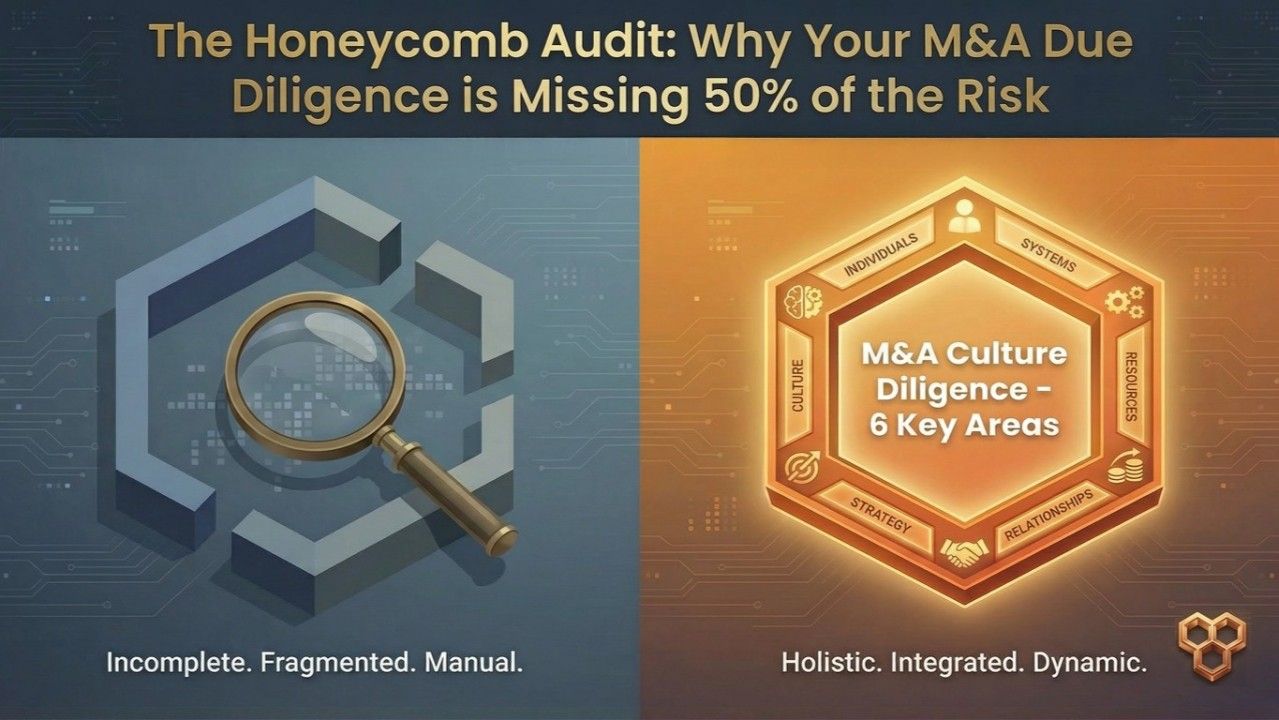
Deployed in just 20 minutes, this zero disruption diagnostic technology captures both rigorous quantitative data and deep qualitative feedback across the six predictive indicators of M&A success: Culture, Relationships, Individuals, Strategy, Systems, and Resources.
This provides the Investment Committee with a quantifiable baseline. It identifies immediate flight risks among key talent, isolates toxic subcultures, and pinpoints the exact operational bottlenecks that threaten the deal model.
Step 2: Applying Executive Brainstorming, Commercial Strategy and Executive Intuition
Data without context is merely noise. A report indicating a low score in strategic alignment does not reveal whether the target leadership team will actively resist a new operating model. This is where human judgement becomes critical.
We do not simply hand over a report card. We take the quantitative and qualitative data collected by the OHS and use it as the foundation for strategic brainstorming. By synthesising this hard data with executive wisdom and intuition, deep organisational knowledge, and decades of commercial experience, we translate raw numbers into actionable commercial reality.
For example, the data may reveal a Level 3 (based on The Management Shift framework) bureaucratic acquirer is attempting to integrate a Level 4 agile target. The data identifies the maturity mismatch. Strategic brainstorming then designs the solution: deploying protective ring fencing to preserve the target's innovation engine, rather than diminishing it through forced standardisation.
Securing the Investment Thesis
Top quartile firms do not leave Execution Capacity to chance. They understand that algorithms cannot negotiate alignment, and gut feel cannot justify a price chip.
By combining rigorous, data driven diagnostics with executive wisdom and intuition, you gain forensic visibility into the target asset. You identify the Execution Friction before it impacts the P&L, and you construct a precise roadmap that accelerates Synergy Realisation.
Do not allow unquantified Human Capital Risk to erode your deal value. Join the investors who are already securing Execution Capacity before the deal closes.
Professor Vlatka Ariaana Hlupic The Culture Intelligence Institute
Access the M&A Red Flag Risk Report Here
#PrivateEquity #MergersAndAcquisitions #DueDiligence #ValueCreation #SynergyRealisation #CII