Unlocking M&A Success: How the Organisational Health Scan Mitigates Culture and People Integration Risks
(c) 2026 Management Shift Solutions
Mergers and acquisitions (M&A) continue to be a cornerstone strategy for business growth and sector leadership. However, studies show that 30-70% of M&A deals fail to achieve their projected value. Whilst rigorous financial, operational, and legal due diligence is normally conducted, organisational culture due diligence and integration are often neglected, and this is one of the most significant but often overlooked reasons for M&A failure.
The Critical Challenge of Culture in M&A
Research from academia and consulting industry consistently quantifies the vast impact of cultural and people integration missteps on M&A success. Estimates suggest that between 20% and 70% of deal value is placed at risk due to poor culture fit, leadership misalignment, and employee disengagement.
The consequences are severe:
- High talent attrition with key employees leaving (30–50%) post-merger,
- Dramatic declines in employee engagement (up to 77%) that sap productivity, which direct impact on decline in profit,
- Delayed and reduced achievement of cost and revenue synergies,
- Annual income losses exceeding £600 million on large deals from cultural mismatch,
- Increased operational expenditures due to poor integration,
- Deteriorated innovation and market responsiveness.
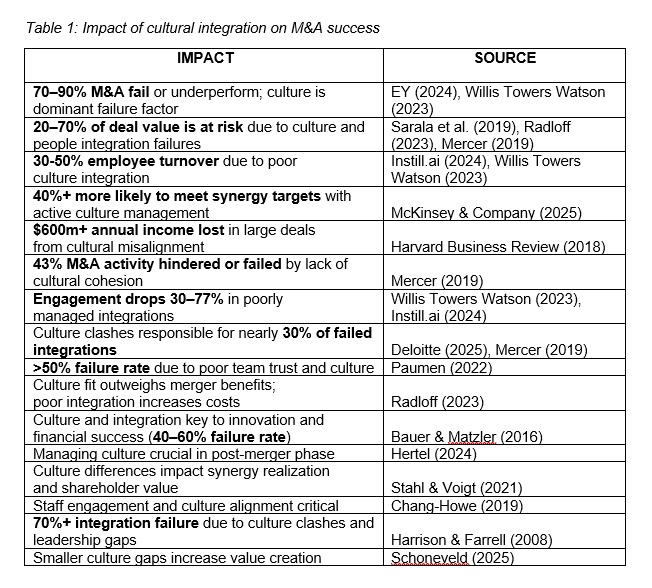
Numerous peer-reviewed studies and consultancy reports confirm these findings, as summarised in Table 1.
Introducing the Organisational Health Scan: A Proven Solution
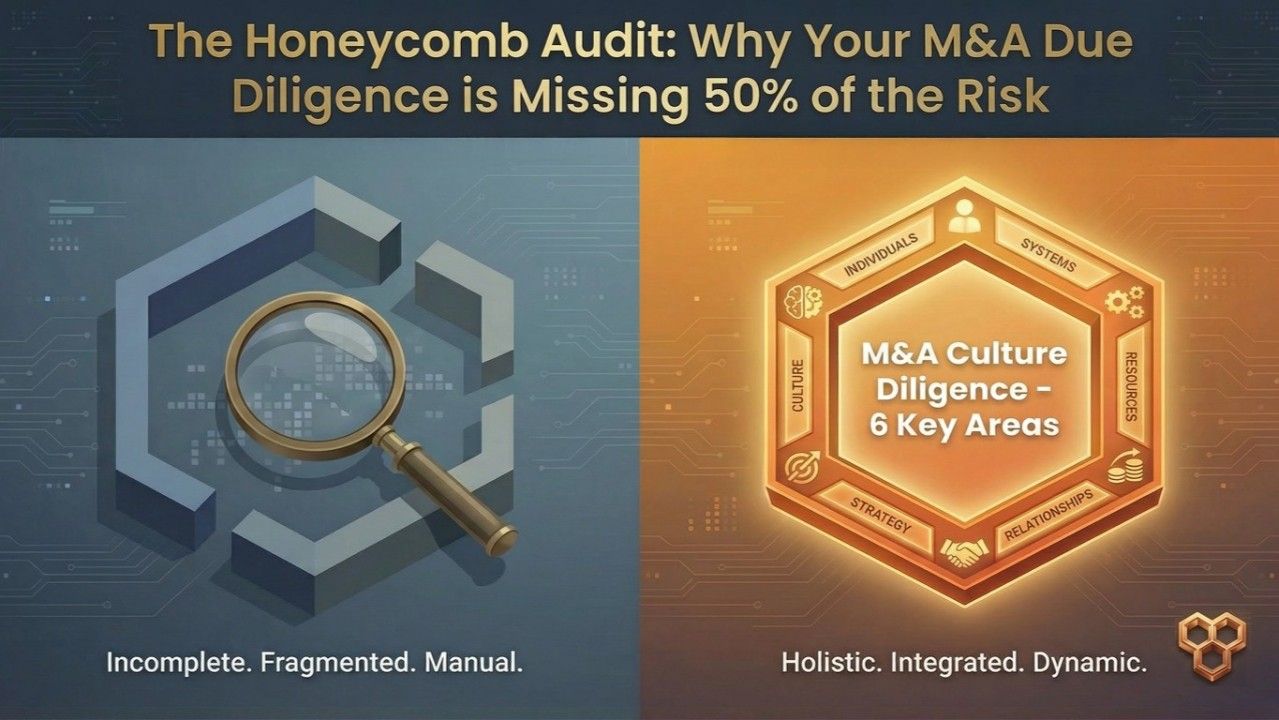
The Organisational Health Scan developed by Management Shift Solutions is an evidence-based, scientifically validated diagnostic providing organisations a holistic 360-degree view of their culture, leadership, and operational health. It assesses six pillars essential to success: Culture, Relationships, Individuals, Strategy, Systems and Resources.
Collecting anonymous, data-driven insights from leadership teams and workforce, the Scan produces a culture risk score and delivers a targeted, prioritised roadmap for action to improve performance, get insight on culture due diligence or help with post-merger culture integration. This enables leaders to identify and mitigate risks early, before damage to engagement, performance, or deal value occurs.
Measurable Impact: Real Client Success Stories
Multiple organisations globally have leveraged The Management Shift (TMS) frameworks and tools for transformation (including the Organisational Health Scan) with dramatic results.
A flagship client in the FTSE 100 luxury retail sector in the UK experienced remarkable transformation over three years after TMS organisational diagnostic tool was used as part of their performance improvement initiative, achieving a 55.2% increase in revenue, a 53.0% rise in profit before tax, and a 35.2% growth in net cash, demonstrating substantial bottom-line improvements.
In the US, a management consultancy engaged in a focused growth strategy project guided by TMS organisational diagnostics, witnessed a 500% profit increase and successfully doubled its team size from 9 to 18 employees within just 18 months, highlighting exceptional scalability and profitability (Hlupic, 2014). The UK’s Learn Direct saw its operating profit soar by 211% within one year, showcasing rapid financial turnaround underpinned by leadership and culture changes.
At
Bowman Riley, following TMS system led transformation,
leadership engagement scores rose by 8% in just one year, accompanied by notable overall improvements in organisational vibrancy, creativity, and performance, reflecting healthier workplace cultures and motivated teams (Hlupic, 2025).
Technology giant SAP, in the APJ region, scored
an impressive 87% on its Business Health and Culture Index. This shift propelled breakthroughs in innovation, customer engagement, and internal relationships, driving sustainable competitive advantage (Hlupic, 2023a).
The public sector organisation in Norway, Innovation Norway, after implementing TMS system for transformation, realised staggering productivity gains, a 1400% increase in efficiency/performance within two years, a 24% boost in service delivery, a 6% reduction in operating expenses, and £59 million returned in dividends to state owners, underscoring the economic impact of organisational health (Hlupic, 2021).
Another TMS project implemented by international
IT consultancy Emergn, significantly enhanced its organisational culture,
doubling survey participation from
40% to 75% and
advancing from the 50th to the 80th percentile in culture and
performance metrics, reflecting deeper employee engagement and operational improvement (Hlupic, 2023b).
Why Organisational Health is the Strategic Winning Edge
For private equity firms, corporate boards, and C-suite executives, the data is indisputable: only by rigorously diagnosing and acting on organisational health and culture risks can true M&A value be unlocked. The Organisational Health Scan transforms people and culture from a source of risk into a competitive advantage, driving accelerated integration, innovation, and returns.
The board should prioritise integrating the Organisational Health Scan into M&A due diligence and integration plans, maximising ROI and minimising the substantial financial risks that culture and people misalignment represent.
For more information or to request a complimentary scan,
click here for our OHS Scan.
References
1. Bauer, F., & Matzler, K. (2016). M&A and innovation: The role of integration and cultural differences. Research Policy, 45(2), 384–396. https://www.sciencedirect.com/science/article/abs/pii/S0969593114001152
2. Chang-Howe, W. (2019). The challenge of HR integration: A review of the M&A HR literature and future research directions. Journal of Chinese Human Resource Management, 10(2), 87–106.
3. Deloitte. (2025). The future of human capital in M&A. https://www.deloitte.com/lu/en/our-thinking/future-of-advice/the-future-of-human-capital-in-m-and-a.html
4. Emergn (2025). Case study: How Emergn improved participation and performance amongst leadership with The Management Shift approach. HRD Connect. https://www.hrdconnect.com/casestudy/how-emergn-improved-participation-and-performance-amongst-leadership-with-the-management-shift-approach/
5. EY. (2024). How culture can unlock M&A performance. https://www.ey.com/en_uk/insights/workforce/how-culture-can-unlock-m-a-performance
6. Harrison, S., & Farrell, P. (2008). Measuring post-merger success: Integration, human factors and construction industry outcomes. In ARCOM Conference Proceedings (pp. 3–12). http://www.arcom.ac.uk/-docs/proceedings/ar2008-3-12_Harrison_and_Farrell.pdf
7. Hertel, T. (2024). Corporate culture and M&A deals: Using text from employees to understand post-merger outcomes. Journal of Corporate Finance, 85, 102705. https://www.sciencedirect.com/science/article/pii/S0378426624000384
8. Hlupic V. (2014) “The Management Shift - How to Harness the Power of People and Transform Your Organization for Sustainable Success”, Palgrave Macmillan:Basingstoke
9. Hlupic V. (2021) Vlatka Hlupic: “Transforming a public sector organisation in times of change”, LSE Business Review, https://blogs.lse.ac.uk/businessreview/2021/04/20/transforming-a-public-sector-organisation-in-times-of-change/
10. Hlupic V.A. (2025) ”How Bowman Riley Architects Elevated Leadership and Culture with The Management Shift Approach”, HRD Connect, https://www.hrdconnect.com/2025/03/26/how-bowman-riley-architects-elevated-leadership-and-culture-with-the-management-shift-approach/
11. Hlupic V.A. (2023a) ”Employee mindset shift: How SAP inspired its employees to innovate and achieve breakthrough by eliminating status quo and process”, HRD Connect, https://www.hrdconnect.com/2023/12/11/employee-mindset-shift-how-sap-inspired-its-employees-to-innovate-and-achieve-breakthrough-by-eliminating-status-quo-and-process/
12. Hlupic V.A. (2023b): ”How Emergn improved participation and performance among leadership with The Management Shift approach”, https://www.hrdconnect.com/casestudy/how-emergn-improved-participation-and-performance-amongst-leadership-with-the-management-shift-approach/, HRD Connect.
13. Instill.ai. (2024). Culture correlations: The reason why 60% of mergers and acquisitions fail.
14. McKinsey & Company. (2025). Why managing culture is critical for value creation in M&A. https://www.mckinsey.com/insights/why-managing-culture-is-critical-for-value-creation-in-m-and-a
15. Mercer. (2019). Global culture survey on M&A integration.
16. Paumen, T. (2022). Consequences of M&A team composition for deal outcomes. Journal of Organizational Behavior, 43(10), 1769–1787. https://pmc.ncbi.nlm.nih.gov/articles/PMC9575689/
17. Radloff, S. (2023). The influence of culture on the performance of mergers & acquisitions (Doctoral thesis). TU Wien. https://repositum.tuwien.at/bitstream/20.500.12708/194665/1/Radloff%20Sarah%20-%202023%20-%20The%20Influence%20of%20Culture%20on%20the%20Performance%20of%20Mergers...pdf
18. Sarala, R. M., Vaara, E., & Junni, P. (2019). Beyond merger syndrome and cultural differences: New directions for research on the “human side” of global M&As. Journal of International Management, 25(1), 13–27. https://www.sciencedirect.com/science/article/pii/S1090951617303231
19. Schoneveld, L. (2025). Bridging or Breaking? The Role of Cultural Distance in M&A Performance. Tilburg University Repository. http://arno.uvt.nl/show.cgi?fid=181714
20. Stahl, G. K., & Voigt, A. (2021). Unraveling the effects of cultural diversity in teams: A meta-analysis. Journal of International Business Studies, 52(1), 37–66. https://pmc.ncbi.nlm.nih.gov/articles/PMC7812115/
21. Willis Towers Watson (WTW). (2023). The HR guide to people and cultural problems in M&A integrations.