Quantifying Execution Capacity: Driving M&A Internal Rate of Return through Culture Intelligence

(c) 2026 Management Shift Solutions
In the current M&A landscape, the most sophisticated deal teams recognise that culture is the primary driver of investment success. However, few can demonstrate within a financial model how the human element moves the numbers. The Culture Intelligence Institute bridges the gap between thirty years of management science and investment-grade commerciality. By utilising the Organisational Health Scan (OHS), we transform soft signals into hard, quantifiable KPIs that predict post-deal performance and link directly to return on investment.
To join the top-quartile of deals that meet or exceed expectations, investors must view culture not as a vague risk, but as Execution Capacity. The following framework outlines how OHS indicators translate into value protection and capital optimisation across the deal lifecycle.
Headline Indices: Valuation and Thesis Confidence
Organisational Health Scan (OHS)
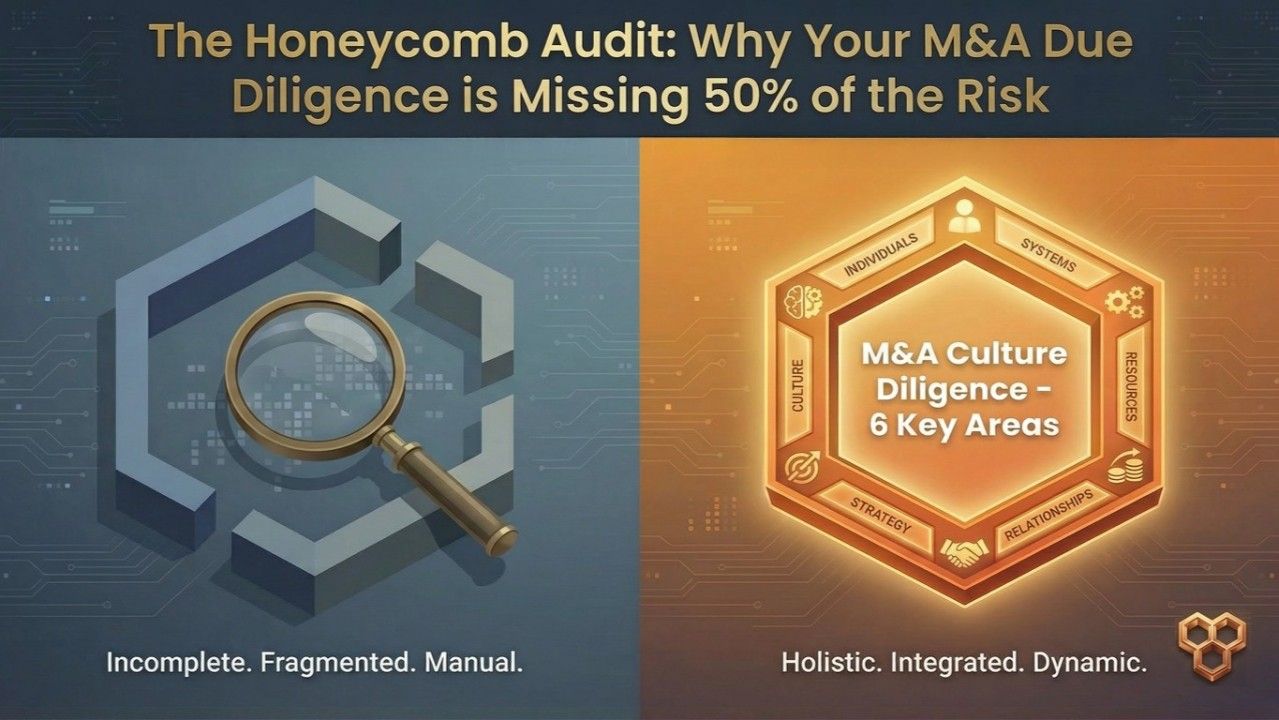
The Organisational Health Scan from the Culture Intelligence Institute provides scores for key drivers of overall organisational health (Culture, Relationships, Individuals, Strategy, Systems, and Resources), indicating whether the target is likely to enable or constrain the deal thesis. Evidence shows that organisations with stronger organisational health significantly outperform those with weaker health in terms of long‑term value creation. A strong OHS result supports more ambitious assumptions on growth, whereas a weak result justifies a Quantifiable Risk Diagnostic and a heavier, more targeted integration budget.
Culture Fit Index
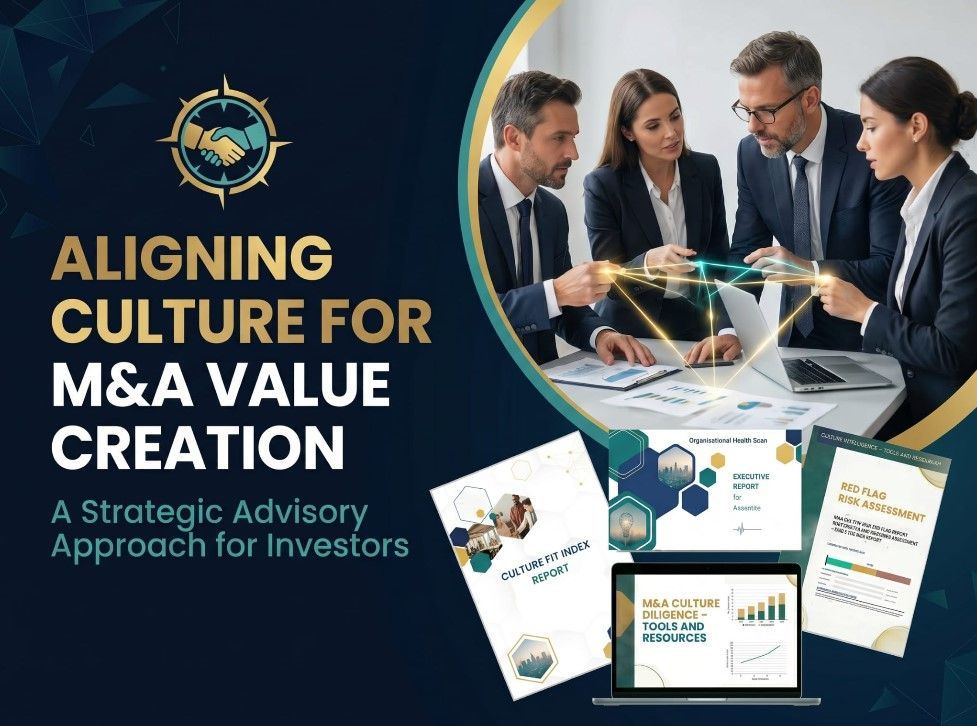
This quantified risk rating compares the acquirer and target across six predictive drivers: Culture, Relationships, Individuals, Strategy, Systems, and Resources, based on analysis from the Organisational Health Scan. Deloitte research consistently cites culture integration as the top cause of deal failure. A high-risk index serves as an early-warning system for a Synergy Realisation Gap, allowing the deal team to adjust synergy timing and costs before the signature is finalised.
Leadership and Alignment: Execution Capacity as a Financial Asset
Leadership Effectiveness and Alignment
Scores on leadership style, trust, and alignment indicate whether the executive team possesses the capacity to deliver the investment case. Misaligned leadership predicts slower decision-making and weaker EBITDA uplift post-close. We view leadership alignment as a proxy for Decision-Making Velocity, which is a critical component of post-merger momentum.
Level of Culture (The Management Shift Levels)
Based on thirty years of interdisciplinary research captured in The Management Shift framework, it is apparent that you cannot achieve Level 4 results, such as innovation and growth, with a Level 3 mindset, which focuses on control and order. Pockets of Level 1 and 2 cultures signal a requirement for a turnaround rather than mere synergy. Conversely, organisations operating in the Asset Zone, which comprises Levels 4 and 5, adapt quickly and accelerate post-deal ROI.
Human Capital Risk: Protecting the P&L
Engagement and Discretionary Effort
Low engagement is a leading indicator of missed cross-sell opportunities and under-delivered revenue synergies. The Gallup Q12 Meta-Analysis demonstrates that top-quartile engaged units achieve 23 per cent higher profitability than those in the bottom quartile. OHS indices capture the willingness of the workforce to go above and beyond, which is a fundamental requirement for complex integrations.
Talent Retention Risk
Identifying Key-Person Dependency and intent to exit allows for the design of a targeted Integration Architecture. Research from Gallup confirms that the cost of replacing a key employee range from 50 per cent to 200 per cent of their annual salary. Reducing unplanned attrition directly protects the P&L from recruitment fees, onboarding downtime, and the loss of critical customer relationships.
Strategy and Operations: From CIM Narrative to Execution Reality
Strategy–Execution Gap
The spreadsheet may say the deal is a winner, but the hallway often says otherwise. This metric assesses whether the workforce understands the strategy and sees it translated into day-to-day priorities. Bain and Company research highlights that culture clashes and a lack of role clarity are the primary reasons for missed synergy targets. A wide gap signals significant Execution Friction and slower delivery of the value-creation plan.
Systems and Integration Readiness
Perceptions of process efficiency and cross-functional collaboration show how ready the organisation is for scaling. Low readiness suggests that IT and process integration will be costlier than planned. By identifying these gaps early, we move the integration plan from a theoretical exercise to a realistic value-creation forecast.
Investment Committee-Ready ROI Modelling
To provide boards with the numbers they require, we anchor our ROI impact in ranges calibrated to deal size. Bain and Company research indicates that active culture management protects the 20 to 30 per cent of synergy value typically lost to integration friction.
Example 1: €30m Bolt-on Acquisition
Context: Service business with a high reliance on people.
Base Case (Standard Diligence):
● Planned Annual Synergies: €1.5m, representing 5 per cent of Target Revenue.
● Historical Realisation Rate: 70 per cent, resulting in €1.05m realised.
● Value Erosion: €450k per year lost in missed efficiency gains and turnover.
The OHS Case Scenario (Culture De-risked):
● Retention Savings: Reducing turnover from 25 per cent to 10 per cent saves €200k in Year 1.
● Synergy Capture: One Team alignment allows for 95 per cent realisation, or €1.42m.
● Hard ROI: Annual EBITDA impact of +€475k per year. At a 10x exit multiple, this creates €4.75m in additional Enterprise Value, driving a 2 to 3 percentage point IRR uplift over a five-year hold.
Example 2: €250m Platform Acquisition
Base Case (No Structured Diligence):
● Planned Synergies: €25m, representing 10 per cent of Enterprise Value.
● Realistic Realisation: 70 per cent, or €17.5m.
● Overruns: €8m in reorganisation, IT, and rehiring costs.
The OHS Case Scenario (CII Integration Architecture):
● Improved Realisation: 90 per cent realisation, amounting to €22.5m.
● Reduced Leakage: Integration overruns reduced from €8m to €5m through better leadership alignment.
● Hard ROI: €5m extra annual EBITDA multiplied by a 10x Multiple equals €50m additional Enterprise Value. This equates to a 2 to 4 percentage point IRR uplift over a five-year hold, depending on leverage assumptions.
The Boardroom Conclusion
If you hire a strategy firm, you receive a plan. If you hire a head-hunter, you receive a leader. However, if you do not hire culture consultant, you are betting your entire investment thesis on the hope that a Level 3 bureaucracy will not suffocate Level 4 growth. Hope is not a strategy.
The OHS provides the data-led architecture to ensure your organisation can deliver the synergies you have promised the board. We do not merely tell you what to do: we ensure the vehicle can do it.
We invite you to initiate a complimentary pre-signing Red Flag Risk Assessment or view a professional snapshot of the OHS methodology in action. Discover how this architecture can remove risk from your next transaction and quantify a tangible return on investment for your team.